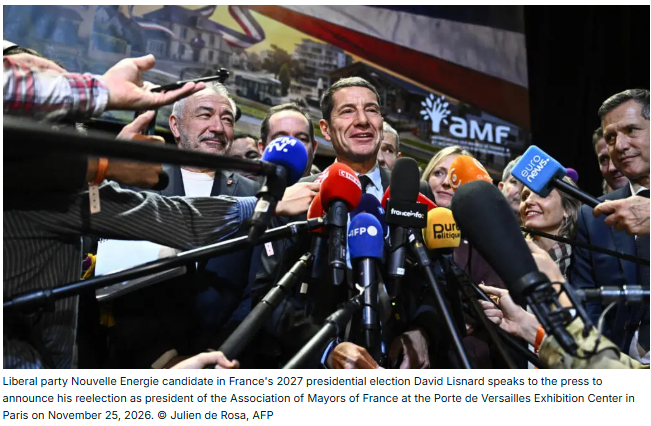
David Lisnard has turned a local-government career into an unexpected, serious bid in France’s 2027 presidential race. The mayor of Cannes and newly reelected leader of France's Association of Mayors (AMF) is pitching a radical, pro-market break with President Emmanuel Macron’s cautious centre-right economic attempts to balance fiscal discipline alongside social-state pressures. And in doing so, he is emerging as a legitimate contender set to complicate far-right candidate Marine Le Pen’s pursuit of power.
Barely a household name six months ago, a November 23 poll by Toluna Harris Interactive estimates Lisnard to have an 11 percent hold in current electoral projections – positioning him ahead of Macron’s former prime minister Édouard Philippe (10 percent) who is vying for the presidency with his own centre-right party, Horizons, and on a level pegging with Socialist frontrunner Raphaël Glucksmann.
A digital campaign strategy helped propel Lisnard to participation in the race for the presidency. Enlisting the help of political spin doctor Frank Tapiro – responsible for helping push former president Nicolas Sarkozy’s 2007 campaign, and a regular guest on polarising news channel CNews owned by media magnate Vincent Bolloré – Lisnard set about building his brand.
With a seemingly lukewarm #IlSePasseQuelqueChose (“Something is happening”) hashtag gaining traction among supporters and opponents alike, Lisnard soon became the subject of a somewhat successful social media push with his newly formed Nouvelle Énergie (New Energy, or NE) party, amassing nearly 150,000 members.
NE advocates for economic liberalism, administrative reform and socio-cultural conservatism. As the movement’s leader, Lisnard views France as overregulated, overtaxed and weighed down by a state that promises too much and delivers too little. He aims to overhaul the very notion of the French institution: to modernise the economy, support business and address what he describes as France’s “international downgrading” (déclassement) without striving for the populist-nationalist EU “reform-from-within” proposals being put forward by his far-right rivals at the National Rally (RN) party. When unveiling his party’s policy programme in April, he took to a shredder to “put an end to bureaucracy”, destroying printed copies of France’s labour, environmental and urban regulations before the cameras.
The man (almost) from Cannes
Born in 1969 in Limoges, Lisnard’s political roots hail from a local base – far from the supreme national Élysée machine. He first set foot on a political path when he joined Cannes’ municipal council in 2001, before becoming the southern French city’s mayor with Sarkozy's support in 2014. In addition to his mayoral reelection in March 2026, Lisnard has served as head of the AMF since 2021 – securing reelection once more on November 25, 2026 – and leads the body that represents France’s communes and intercommunal authorities comprising approximately 34,000 municipalities.
As leader of the AMF, Lisnard has access to a prominent platform through which he can promote his pitch in favour of decentralisation – arguing for increased local autonomy and renewed control over municipal finances. But his role at the helm also places him in a precarious position: as a representative body for diverse political voices, critics cite concerns around both influence and duality, debating whether it’s truly possible to campaign for the presidency while leading France’s grassroots community representatives.
French presidential elections 2027: More candidates, more confusion
‘Dégagisme’
However, Lisnard’s national ascent is not one of entirely outsider politics. Almost a decade ago, he served as political adviser and spokesperson for former prime minister François Fillon during his 2017 presidential campaign. He proceeded to formally leave the right-leaning Les Républicains (LR) party – currently led by presidential candidate Bruno Ratailleau – claiming the conservative group had lost its direction. While supporters of his new movement say his experience offers him an astute understanding of the French state system, his critics contend that his “anti-establishment” image obscures a long and targeted career within the political system.
French media frames Lisnard through a lens of "dégagisme" (dégager meaning "to get out"), a political undercurrent that seeks to clear out the entrenched elite and to return power to France’s citizens. Indeed, should Lisnard’s presidential bid prove successful when the French go to the polls on April 18, 2027, his first proposal aims to align with his party’s ambitions to overhaul the system through a pledge to cut public spending by €200-€300 billion over the next five-year presidential term – including by €80 billion in the first year. To do so, Lisnard plans to shrink the civil service, dismantle municipal agencies and reduce regulation, ending what he calls ineffective subsidies and redirecting the state’s focus on its core duties.
A longstanding proponent of Argentina's right-wing populist and libertarian President Javier Milei, Lisnard has also embraced the power of political spectacle. Milei's 2023 presidential campaign featured a chainsaw as a symbol of his promise to slash state spending; Lisnard meanwhile plans to eliminate 400,000-500,000 civil-service jobs through attrition and cuts and to place all teachers on fixed-term contracts.
Far-right friend – or 'faux'?
But it’s Lisnard’s economic agenda that marks his strongest contrast with Le Pen, the race’s current frontrunner. Whereas Le Pen’s RN party combines nationalist politics with economic protectionism, Lisnard seeks a smaller state, fewer employees and a more liberal economy. He argues that the current model burdens taxpayers and stifles growth.
On immigration and national identity, however, both leaders converge more closely. Lisnard’s NE party aims to abolish State Medical Assistance (AME), which provides healthcare to undocumented migrants, and it seeks to restrict access by foreign nationals to non-contributory social benefits. Alongside Lisnard’s use of socially conservative language and “anti-woke” stance, his refusal to say who he would support in a hypothetical contest between Le Pen and Philippe has led to claims he is doing everything he can to accommodate the far right – even attempting to court it.
"There is something that bothers me, and that is (Lisnard’s) closeness to [Mayor of Nice and Union des droites pour la République (Union of the Right for the Republic) party founder] Éric Ciotti. When you make overtures to Éric Ciotti by saying he is wonderful, in reality, you are making overtures to Marine Le Pen," LR party-member and Mayer of Meaux Jean-François Copé said on a broadcast with BFMTV on November 1.
Campaign controversy
So far, Lisnard’s campaign has not been controversy-free. In response to a question about the October 17, 1961 massacre of Algerian demonstrators by Parisian police on a televised LCI debate, he said: “I don’t care. I couldn’t give a damn; I wasn’t even born,' provoking widespread criticism and pinning him as a political liability.
But his blunt manner has also helped raise his profile. “You’re going to pay for people who do nothing,” he said on September 15 in a Facebook video that has so far garnered nearly two million views. Its title? “David Lisnard deciphers the socialist rhetoric of the political class.”
Lisnard’s candidacy is perhaps less a conventional presidential campaign than a test of whether sticking two fingers to the establishment can gain political ground. To date, his rise has been built on a crowded centrist and right-leaning political landscape including LR leader Retailleau, Philippe and former prime minister Gabriel Attal – coupled with the fact that Macron cannot run for a third consecutive term. But France will wait to see whether Lisnard can remain more than a slogan, and whether "something" really is "happening".