New Zealand will hold a general election on November 7th, with the center-right coalition led by the National Party and the center-left opposition neck and neck. Given the current balance of power, smaller parties could once again play a decisive role in forming the government.
New Zealand enters a crucial phase of its general election campaign, with opinion polls showing a close race between the ruling coalition led by the National Party and the opposition, in which the Labour Party is the largest force.
Analysts believe it is unlikely that any single party will win enough seats to form a government on its own. Therefore, the ability to assemble a coalition and the choices of smaller political parties could determine who will lead New Zealand in the next term, similar to the outcome after the 2023 election.
The economy, cost of living, public services, immigration, energy, and political system reform are becoming major themes in the movement.
National Party: Prime Minister seeks a second term.
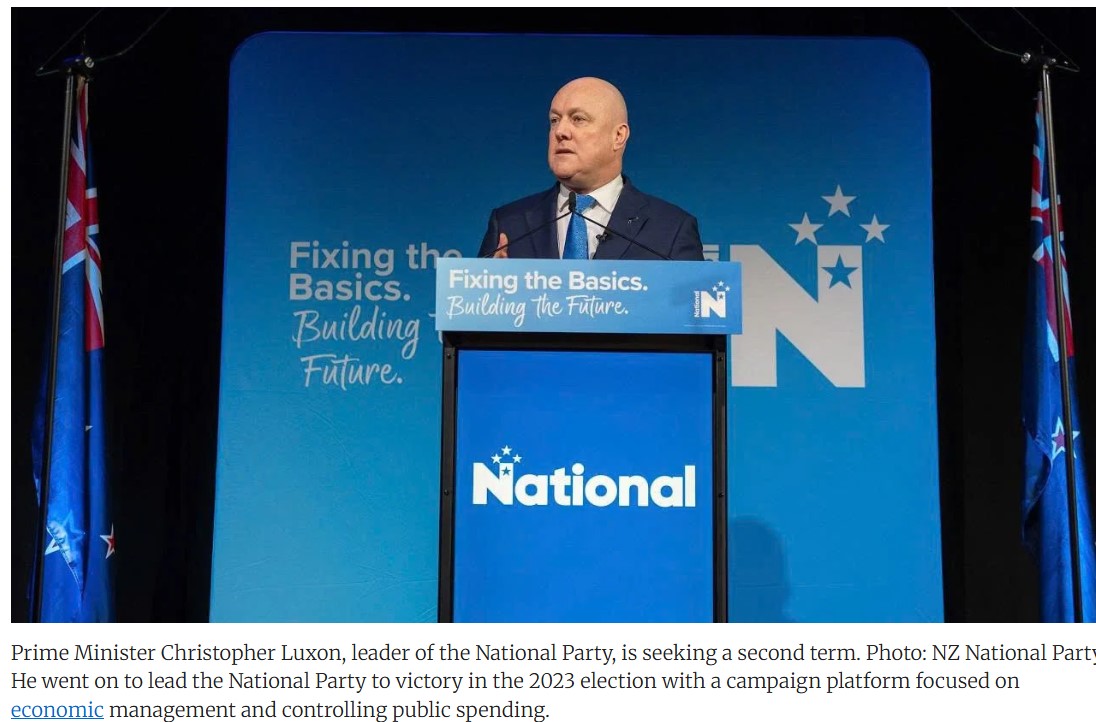
Prime Minister Christopher Luxon, 56, is seeking a second term as head of government. He was first elected to Parliament in 2020, representing the Botany constituency in Auckland, and became leader of the National Party a year later. Prior to entering politics, he served as CEO of Air New Zealand.
However, Luxon's leadership has been fraught with turmoil. The Prime Minister survived two internal confidence votes in April and August 2026. The second vote came after then-Defense Secretary Chris Penk challenged his leadership, amid declining party approval ratings, a strained economy, and divisions within the three-party coalition.
In its 2026 campaign, the National Party continues to focus on the economy. The party aims to bring the budget back into surplus and expand the national KiwiSaver retirement savings program.
The Labor Party seeks a return to government leadership.
Labour leader Chris Hipkins, 48, is seeking a return to the premiership, three years after the party's defeat in the 2023 election. Hipkins was first elected to Parliament in 2008. In January 2023, he became Prime Minister after Jacinda Ardern resigned, but held the position for less than a year before the Labour Party lost the general election that October.
The Labour Party's 2026 election platform focuses on reducing the burden of living through more affordable healthcare and transportation; investing in jobs, housing, and infrastructure; and strengthening public services.
The Labor Party's chances of returning to power will depend not only on the number of seats it wins, but also on its ability to rally support from the Green Party, Te Pāti Māori, and possibly other smaller forces.
New Zealand First: The familiar "decision-maker"
Winston Peters, led by New Zealand First, continues to be seen as one of the forces that can determine the balance of power. Peters served as Deputy Prime Minister until May 2025 and has led New Zealand First in coalition governments with both the Labour and National parties since the 1990s. His ability to cooperate with both sides has often made the party the "decisive factor" after elections.
In this year's campaign, New Zealand First proposes limiting voting rights in New Zealand elections to New Zealand citizens, instead of applying them to certain eligible permanent residents as is currently the case.
The party also proposed splitting up large power companies that simultaneously handle electricity generation and retail sales; and splitting one of the largest supermarket operators into two companies to increase competition in the retail market.
Mr. Peters wants New Zealand to withdraw from the Paris Agreement on climate change and proposes bringing the central bank back to a dual-objective mechanism, including controlling inflation and supporting sustainable employment.
ACT New Zealand tightens its stance on immigration.
ACT New Zealand describes itself as a classic liberal party with a focus on individual liberty and market principles. The party currently holds 11 of the 123 seats in Parliament and is the smaller member of a three-party coalition with the National Party and New Zealand First. ACT has been led by David Seymour since October 2014. Seymour is expected to serve as Deputy Prime Minister from mid-2025.
Ahead of the 2026 election, the ACT has put forward a six-point plan on immigration. Proposals include deporting serious offenders regardless of how long they have lived in New Zealand; imposing a surcharge on temporary work visas; and requiring new permanent residency visa holders to wait five years before accessing certain government benefits.
This program could appeal to voters who want tighter immigration controls, but it also risks increasing divisions within the ruling coalition and debate over immigrant rights.
The Green Party focuses on the cost of living and energy.
The Green Party, a left-wing force that has supported Labour-led governments, is now co-led by Chlöe Swarbrick and Marama Davidson. The three central themes of the party's 2026 campaign are reducing the cost of living, protecting the environment, and reforming political finance.
The Green Party proposes a property tax, increased taxes on large businesses, banks, and profits of foreign technology corporations. At the same time, the party wants to exempt the first 10,000 NZD of income from tax and reduce income tax for the majority of taxpayers.
In the energy sector, the party proposed establishing the state-owned power company Kiwipower; expanding the home insulation program; providing interest-free loans for households to install solar power and battery storage; and supporting community-owned renewable energy projects.
The Green Party also wants to establish the KiwiMart supermarket chain and implement stronger regulations to prevent price gouging in the food market.
The Maori Party is betting on seats reserved for indigenous people.
The Maori Party, the party of New Zealand's indigenous community, currently has less support than the 5% threshold needed to win parliamentary seats based on national vote percentages. However, the party still has a chance to return to the legislature through Maori-specific constituencies.
New Zealand currently has seven special seats reserved for voters registered on the Maori electoral list. The Maori Party controls six of these seats and aims to encourage more Maori voters to register on this list.
The party has been co-led by Rawiri Waititi and Debbie Ngarewa-Packer since October 2020. According to Ngarewa-Packer, the Maori Party's campaign platform also focuses on housing, healthcare, education, environmental protection, and constitutional reform. The results in the seven Maori constituencies could significantly impact the balance of seats between the two political blocs.
The Opportunist Party is seeking an "opportunity" to gain a foothold in Parliament.
The Opportunity Party was founded in 2016 by economist Gareth Morgan. The party has participated in three general elections but has never won a seat, with its highest result being 2.6% of the vote in 2017. The party is currently led by Qiulae Wong, an Auckland businesswoman. She was appointed in November 2025 and is the fifth person to hold the leadership position.
Ms. Wong asserted that the Opportunity Party pursues feasible reforms that are fully cost-calculated and capable of generating concrete economic growth. The party identifies itself as neither left-wing nor right-wing.
The central policy in the 2026 campaign is the land value tax, with an annual rate of 1.75% for residential land and 0.5% for rural land. Opportunity believes this tax could generate NZD 24 billion annually to fund a broader tax reform program.
However, the party's biggest challenge remains crossing the electoral threshold or winning in at least one region to gain representation in Parliament for the first time.
The race of alliances
The general election on November 7th is not just a direct competition between Christopher Luxon and Chris Hipkins. It's also a race between two potential coalition structures.
The National Party needs to maintain the support of ACT and New Zealand First to remain in power. The Labour Party will likely have to rely on the Green Party and the Maori Party if it wants to return to government.
In a close election, with only a few seats reserved for Maori, a small shift in the New Zealand First party's vote share or the Opportunity Party's first-ever entry into Parliament could alter the balance of power.
Therefore, the outcome of the New Zealand election will be determined not only by which party wins the most votes, but also by which party is able to build a coalition with enough seats and maintain the unity to form the next government.