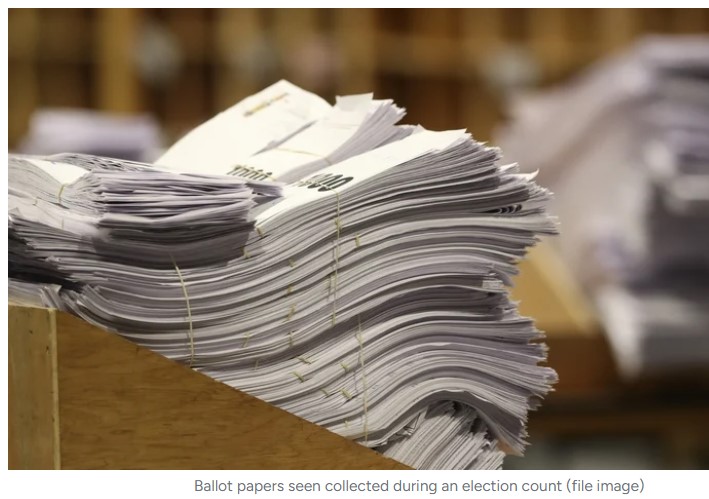
More than 400,000 names have been removed from the electoral register in the past three years because individuals have emigrated, received multiple ballots incorrectly or have died.
The figure was confirmed by State electoral body An Coimisiún Toghcháin at a meeting of the Oireachtas Committee on Housing, Local Government and Heritage.
Asked about the voting register and its accuracy, An Coimisiún Chief Executive Art O'Leary confirmed that since the group was established in early 2023 more than 400,000 names have been removed from official voter lists.
Responding to questions from TDs and senators, he said this was because of issues including people emigrating, individuals receiving multiple ballots incorrectly because they have moved, or if they have died.
Mr O'Leary said the electoral register "is the foundation stone of our democracy and elections", and that while it "will never be perfect, it's a living document".
Fine Gael TD Joe Cooney asked what action is being taken to address the fact that more than 70% of the people who do not vote are under the age of 35, while the Social Democrats' Rory Hearne who raised similar questions.
Asked by Fine Gael TD Paula Butterly "would it help to have compulsory voting" like in Australia, Mr O'Leary responded that "Australia admits that if compulsory [voting] was introduced now, they'd never get away with it".
He added that while some people believe it sounds like a practical idea, there are many legitimate reasons why some people do not vote, and said what is often ignored is that Australian officials use "helicopters, fleets, boats" to travel to communities to ensure people vote.
"That costs the Australians AUS$6bn (€3.6bn) to run an election, because they go to those lengths," he said, adding this may not be a popular proposal in Ireland.
Election posters should not be banned
Meanwhile, speaking during the same meeting, Mr O'Leary said An Coimisiún believes electoral posters should not be banned during campaigns.
Explaining the view to TDs and senators, he said while the posters' ability to divide opinion means they are "the electoral version of marmite", the posters still play an important role in Irish democracy.
Mr O'Leary said more than 200,000 posters are used by all candidates during an election campaign, amounting to one third of total costs for candidates.
He said people also hold strong views on their use, with recent surveys indicating a significant percentage of the public do not support the continued reliance on posters on lampposts.
However, despite this view, Mr O'Leary said "we are not recommending that electoral posters disappear", due in part to what he said was their important role in informing voters of elections and the costs amount to "one third of coffee cups used a day, or two flights to the United States".
Instead, he argued that better enforcement of existing rules, new limitations on poster sizes and shapes, and improved information on where and when posters should be disposed could be considered.
Responding to the position, Fianna Fáil TD Séamus McGrath said "marmite is a good description" and that in his view "those recommendations fall short of what people are looking for", as there is "nothing that prevents a candidate having 1,000 electoral posters" on local lampposts.
Deputy McGrath said "my sense is there's a strong view out there there should be limitations", a position repeated by a number of TDs including Sinn Fein's Eoin Ó Broin who argued that he believes less posters at more focused times during a campaign is the most effective route for campaigns.
Independent TD Barry Heneghan separately raised the approach to electoral posters in Geneva, Switzerland, where he said there are "areas in the city where posters are allowed".
While Deputy Heneghan asked "why not ban posters" or introduce limitations, Mr O'Leary said "it's the difficulties about enforcement", as "one of the real issues" would be that "posters would probably have to be numbered one to 50" to ensure the number limit is not exceeded.