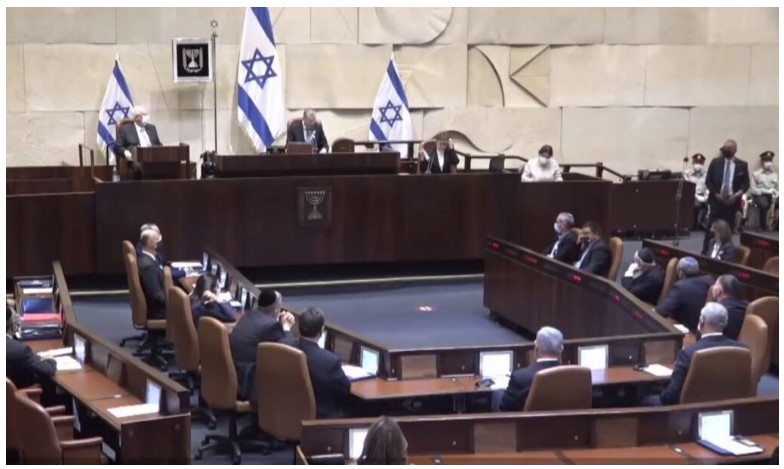
The Knesset has 120 members, elected by a proportional system, and to form a government it is necessary to have the support of at least 61 parliamentarians.
With two weeks to go before Israel's parliamentary elections on October 27, polls paint a mixed picture for the prime minister. Benjamin Netanyahu, grappling with the challenge of the former Chief of Staff of the Army Gadi Eisenkot and with an opposition trying to build an alternative majority. According to a poll published yesterday by the Israeli broadcaster "Channel 12," considered predominantly centrist and generally critical of the prime minister, Eisenkot's Yashar party would win 23 seats in the Knesset, Israel's parliament, surpassing Netanyahu's Likud party, which holds 20. A second poll, also released yesterday by "Channel 14," a right-wing nationalist broadcaster openly supportive of Netanyahu, paints a different picture: Likud would lead with 29 seats, compared to Yashar's 20, and the governing coalition would achieve an absolute majority. The differences between the polls confirm the strong polarization of the Israeli political landscape, as the country prepares to vote three years after the Hamas attack of October 7, 2023, and the subsequent wars in the Gaza Strip and the region.
To understand the significance of the results, it's important to consider that the Knesset has 120 members, elected by proportional representation, and that forming a government requires the support of at least 61 members. None of Israel's main political parties is capable of reaching this threshold alone, making inter-party agreements essential. According to "Channel 12," the Zionist parties opposed to Netanyahu would obtain a total of 54 seats, compared to the 49 seats of the parties supporting the current government. Another 13 MPs would go to two parties primarily representing Israel's Arab minority: eight to the Joint List, a left-wing alliance bringing together Hadash, Ta'al, and Balad, led by Yousef Jabareen, and five to Ra'am, a moderate Islamist-inspired party led by Mansour Abbas, already a member of the governing coalition led by Naftali Bennett between 2021 and 2022. The remaining four seats would be won by the alliance between the Reserve Party of former Communications Minister Yoaz Hendel and the New Economy of economist Yaron Zelekha, which presents itself as a force independent of the two main factions. Another four seats would be won by the Hendel-Zelekha alliance, a center-right list uniting the Reservists Movement of former Communications Minister Yoaz Hendel and the party of economist Yaron Zelekha, with a platform focused on military service, reducing the cost of living, and the formation of a national unity government free of Arab and ultra-Orthodox parties. The combined number of opposition parties to Netanyahu would thus reach 67 seats, but it would not automatically guarantee a governing majority: the political differences between the Zionist and Arab parties, combined with the still independent position of the Hendel-Zelekha alliance, could make forming an alternative coalition particularly complex.
Netanyahu's main challenger is Gadi Eisenkot, 66, a retired general who led the Israel Defense Forces from 2015 to 2019. After the Hamas attack of October 7, 2023, he joined the Netanyahu government's war cabinet, from which he later resigned along with former Defense Minister Benny Gantz. Eisenkot has personally experienced the tragedy of war: on December 7, 2023, his son Gal Meir, 25, was killed during a military operation in the Gaza Strip. The following day, he also lost a grandson, 19-year-old Maor Cohen Eisenkot, while a second grandson, 22-year-old Yogev Pazy, died in combat in November 2024. These losses have made him a particularly significant figure in the Israeli debate over political and military responsibility for the conflict. His Yashar party, centrist but with rigorous positions on national security, advocates strengthening democratic institutions, reviewing relations between politics and the military, and establishing accountability for the flaws that allowed the October 7 attack. Eisenkot thus presents himself as an alternative to Netanyahu, capable of appealing to conservative voters as well, leveraging his military experience and the demand for new political leadership.
Another opposition figure is Naftali Bennett, former prime minister from 2021 to 2022, who hails from the nationalist and religious right. Bennett leads the Beyachad list, meaning "Together," formed in an alliance with Yesh Atid, the centrist and liberal party of former Prime Minister Yair Lapid. This coalition, which brings together members of the center and center-right, would win 13 seats, according to "Channel 12." Another nine MPs would go to the Democrats led by Yair Golan, former deputy chief of staff of the army who leads a center-left coalition formed by the Labor Party and Meretz. Nine seats would also be won by Israel Beitenu, led by Avigdor Lieberman, a former defense minister and exponent of the nationalist and secular right, opposed to the influence of religious parties on public life and now aligned against Netanyahu.
The government coalition, however, remains centered around the Likud, the right-wing conservative and nationalist party led by Netanyahu, supported by religious and ultranationalist groups. According to Channel 12, Otzma Yehudit, the far-right party of National Security Minister Itamar Ben Gvir, would win eight seats, while the Religious Zionist Alliance led by Finance Minister Bezalel Smotrich would win six. Another fifteen MPs would go to the two main ultra-Orthodox parties: Shas, led by Aryeh Deri and rooted primarily among religious Jews of Sephardic and Mizrahi origin, with eight seats, and United Torah Judaism, representing predominantly ultra-Orthodox Ashkenazi communities, with seven. These parties support Netanyahu, while maintaining differing positions on issues such as compulsory military service, funding for religious institutions, and the management of Palestinian territories.
The Channel 12 poll also contains another significant finding. When asked who is best suited to be prime minister, 45 percent of respondents chose Eisenkot, compared to 35 percent for Netanyahu. The former general's lead has increased from three to ten points compared to the previous survey. Bennett also narrowly outperforms the outgoing prime minister, with 37 percent to 36 percent. These are assessments of personal leadership, distinct from party voting intentions.
The picture changes significantly in the Channel 14 poll, which gives the Likud 29 seats and the combined parties allied with Netanyahu 61 seats, precisely the number needed to govern. The poll instead assigns 46 seats to the opposition parties and another 13 to the Arab parties. The broadcaster's polls, conducted by the institute linked to pollster Shlomo Filber, traditionally tend to attribute more favorable results to the right than most other Israeli polls. According to the aggregator "Israel Votes 2026," which considers the latest polls from eight different media outlets, Netanyahu's bloc would average around 54 seats, while the Zionist opposition parties would obtain around 49. Only one of the eight polls considered, the Channel 14 poll, gives the incumbent coalition an absolute majority.
With less than two weeks to go until the elections, the situation remains uncertain. Netanyahu's confirmation could depend on his ability to unite his right-wing allies and religious parties, while a potential alternative government would require a consensus among very diverse groups, from secular nationalists to centrists to the left, possibly involving representatives of the Arab minority. A further element of uncertainty is the 3,25 percent threshold, which could exclude some smaller lists and alter the distribution of seats.