The election, held to elect members in all seats of the lower house State Duma, is the first since Moscow launched its full-scale invasion of Ukraine in 2022.
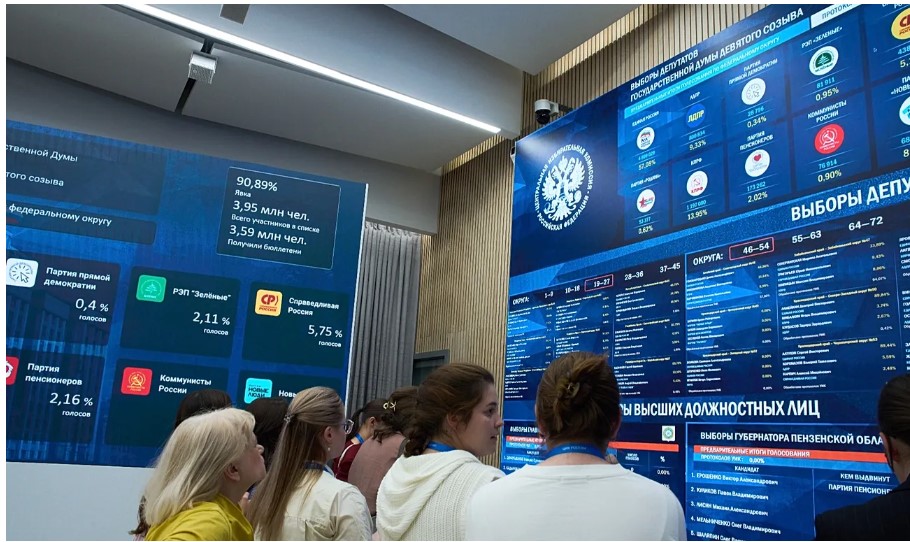
President Vladimir Putin's United Russia party won a record number of 355 seats in Russia's 450-seat State Duma, the lower house of parliament, according to preliminary results released by electoral chief Ella Pamfilova on Monday.
With almost all votes counted after the three-day election with no parties critical of Putin participating, results showed the presidential party will have a supermajority larger than its previous 2016 record of 343 seats.
It was Russia's first parliamentary election since Moscow launched its full-scale invasion of Ukraine in 2022.
The Kremlin tightly controls elections and Moscow has banned criticism of its military campaign in Ukraine.
Pamfilova said turnout was more than 59%, thanking Russians for voting despite what she called "psychological pressure" on the country.
Russia's Communist party came second, winning 40 seats. The nationalist LDPR party took 25 seats and the New People party winning 20 seats.
United Russia has dominated politics since the early 2000s and Putin has been in power since New Year's Eve 1999.
Pamfilova said that more than 95% of votes have been counted and that final results will be announced later this week.
Wave of Ukrainian drones
Ukraine fired waves of drones at Moscow and the surrounding region on the final day of voting on Sunday, killing two people and setting an oil refinery on fire, officials said.
Russia vowed it would "intensify" its strikes on Kyiv in response, with the defence ministry accusing Ukraine of attempting to "disrupt the democratic will of Russian citizens."
"In response to the Kyiv regime's attacks on civilian targets within Russia, the Russian army will continue and intensify its high accuracy strikes against military targets in Kyiv," the Russian defence ministry said.
The Ukrainian attack was the largest on Moscow since the start of the war and involved around 1,600 drones, 450 of which were aimed directly at the capital, Moscow Mayor Sergei Sobyanin said.
Images showed a gaping hole in a multi-storey apartment building on the outskirts of the capital, while another showed black smoke billowing from what appeared to be an oil refinery.
Ukrainian President Volodymyr Zelenskyy praised the attacks, saying "our long-range responses had a very significant impact in the Moscow region last night."
While diplomatic efforts to end the war have not prevented mutual strikes from escalating in recent months, Zelenskyy spoke by phone with US President Donald Trump, who in recent days has urged Kyiv to stop its attacks on Russian refineries.
The pair are expected to meet in New York in the coming days.
Ukraine has targeted Russian infrastructure with drones throughout the war, in retaliation for Russian bombardment of its own towns and cities.
Cyberattacks
As voting entered a final day, Russia's electoral chief said there had been a wave of cyberattacks targeting election infrastructure.
Ella Pamfilova, chair of Russia's Central Election Commission, did not say who was responsible.
The attacks appeared to have been carried out by "highly professional, well-coordinated groups using artificial intelligence tools," she said.
"Over the past period, more than 1,000 waves of DDoS attacks have been recorded against infrastructure in Russia that is specifically involved in the electoral process," Pamfilova was quoted as saying by Russian news agencies.
DDoS (distributed denial-of-service) attacks involve overwhelming a system with internet traffic so that it is unable to function normally.
She warned on Saturday that saboteurs had also severed communication lines in Russia's far east, in an apparent attempt to frustrate the voting.