France's political mainstream faces wipe-out at the presidential election in April-May 2027, unless it acts fast to choose who it wishes to stand.
With every poll confirming the dominance of hard-right and hard-left leaders Marine Le Pen and Jean-Luc Mélenchon, candidates of the middle-ground – the old "legacy" parties – are being squeezed out of the game.
In theory any contender from centre-right or centre-left who was chosen in the first multi-candidate round of voting in April should be in a strong position to win in the play-off a fortnight later.
That is because at their separate ends of the spectrum both Le Pen and Mélenchon have more people who oppose than support them.
But personal rivalries, lack of preparation and differing political visions have so far put paid to any hope of a meaningful challenge.
"The game in the centre is totally blocked," says political writer François Fressoz at the left-leaning Le Monde newspaper. "The partisans of reason have lost their reason."
On the left – the old Socialist Party and its acolytes – there is at least agreement on a candidate: European Parliament MP Raphaël Glucksmann.
His problem is that allies who he might once have counted on – Greens, Communists and other small left-wing parties, not to mention many Socialist voters – are being pulled inexorably into the Mélenchon orbit.
In the last two weeks, Green party leader Marine Tondelier, a majority of Communist parliamentary deputies and one-time Socialist presidential hopeful Benoît Hamon have all thrown in their lot with the leader of France Unbowed (LFI).
Another prominent figure of the left – François Ruffin – has also withdrawn from the race, bowing to the unbowed Mélenchon's now almost total command of the field.
So with the soft-left emasculated, the main hope for an alternative to Le Pen and Mélenchon has to be focused on the right. But here the prospects – which until recently seemed bright – are now clouded with gloom.
"A Mélenchon–Le Pen duel in round two is not yet inevitable," says Guillaume Tabard, political analyst at the conservative Le Figaro newspaper. "But it is looking increasingly probable."
In recent weeks the poll ratings of the main centre-right hopeful Edouard Philippe – a former prime minister under President Macron – have fallen sharply, and he is now consistently placed behind Mélenchon in the first round of the vote. Marine Le Pen is way ahead of both.
Other candidates for command of this centre-right "space" are circling. They include another former Macron prime minister, Gabriel Attal; the leader of the right-wing Republicans (and former Macron interior minister), Bruno Retailleau; and now – a surprise new challenger – the mayor of Cannes, David Lisnard.
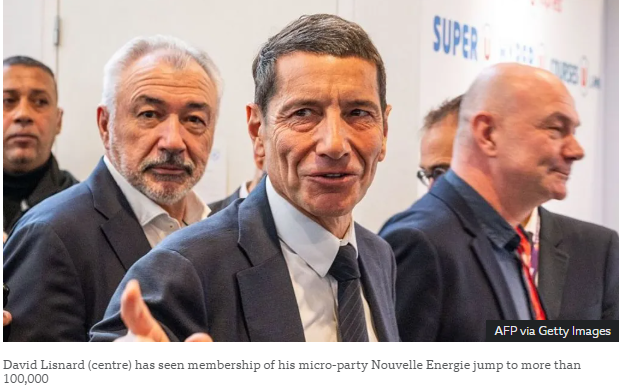
Lisnard, who stands on a liberal economic platform of less state and lower taxes, has emerged from nowhere to become the man of the hour. Membership of his micro-party Nouvelle Energie (New Energy) has shot up to more than 100,000, and he is being taken seriously as a possible Philippe replacement.
But this very multiplicity of names – not to mention others like judoka Teddy Riner, journalist Natacha Polony and former prime minister Dominique de Villepin – betrays the essential weakness of the centre-right challenge.
According to veteran commentator Nicolas Baverez, "If you want to win an election, it's quite simple: you need a strategy, a programme, and activists. Right now in the space between Le Pen and Mélenchon we have none of that: there is a total vacuum.
"The most glaring absence is digital. Mélenchon especially, but Le Pen too, are running extremely effective social media campaigns. In the middle… nothing."
Guillaume Tabard agrees that the lack of a shared platform is proving a serious handicap.
"In recent weeks we have seen Marine Le Pen issue her manifesto proposals for reforming pensions. We have seen Jean-Luc Mélenchon publish his programme in a best-selling book," he says.
"What do we have in between? Arguments about names and polling figures and whether or not there should be a primary. It's not, to put it mildly, an encouraging start."
For Fressoz, "There is no-one in the centre who is taking up the fight. When Le Pen makes her proposals about pensions, there is no-one saying, 'Hang on, that doesn't add up!'. Macron – who did after all take her on and beat her – is said to be furious."
Any mention of Macron, though, is most unwelcome for the camp that nominally is his heir. Philippe, Attal and Retailleau all served under a president who Baverez now calls "as toxic as Trump", so deep is his unpopularity in the country. Lisnard, by contrast, makes much of his refusal to serve under Macron – but he faces another handicap.
According to Fressoz, "Lisnard has shot up in the polls because he is on the right of the right, and there is always an appetite for a figure who is not Le Pen, but who speaks her kind of language on immigration.
"But Lisnard is an economic liberal, and in France that is a minority taste. He'll have his moment but then he will deflate."
With five months to go to until the election, all is not lost for the mainstream. Optimists in its ranks say that come the new year, opinion polls will start settling behind one or other centre-right candidate, and the others will feel obliged to step aside.
Talk of a centre-right primary – as occurred ahead of the 2017 election – is beginning to ebb. The two strongest candidates, Philippe and Lisnard, are opposed. Lisnard says he supports one but his conditions are designed to be unacceptable to the rest. Retailleau and Attal are in favour – but that, says Tabard, is "mainly as a way to keep their hopes alive."
In theory then it is possible a name will emerge in January or February, and start pulling behind him (or less likely, her) the mass of voters who do not want a disruptive radical as France's next head of state.
Possible, but hardly a good bet.
For Fressoz of Le Monde, "After years of Macron's 'neither left nor right', the left and right are once again shaping French politics. But now it is the extremes who are in control."
Le Pen and Mélenchon have both already run three times for the presidency. Their visions were defined long ago, their strategies laid, their activists trained. Polarisation is their friend, so is the social tension of recent weeks, and both are undisputed masters in their own camps.
The 2027 dénouement has been in their sights for years. That is their massive advantage.