TAIPEI, Taiwan (AP) — Taiwan will choose mayors, council members and other local leaders across its 22 cities and counties Saturday, in elections focused largely on local issues but also drawing attention from China, which claims the self-governed island as its territory.
The elections are held once every four years, and will be tightly contested between the ruling Democratic Progressive Party and the Nationalist Party, also known as the Kuomintang or KMT.
While some experts have in the past compared Taiwan’s local elections with the U.S. midterms, as a referendum on the ruling party and its policies, this election cycle has largely focused on bread and butter local issues, without much talk about the island’s relationship with China.
Here’s what to know about these elections.
City council seats, village ward chiefs and mayoral offices up for grabs
From Tainan to Taipei, voters will be choosing between candidates from the DPP and KMT. A third party, the Taiwan People’s Party, is also running in some smaller races, and linking up with the KMT in the Taipei mayoral race to support the KMT candidate.
While in the past, the DPP has often used the narrative of defending Taiwan against China’s threat in local races, little of that was on display this time, experts said. They also noted less aggressive campaigning this time from candidates who were instead more focused on policy issues.
“Many of the candidates, they toned down their attacks, and in order to try and get the swing voters, they talked more about policy,” said Wei-hao Huang, a political science professor at National Sun Yat-sen University.
“How much does the CCP have in actual importance in Taiwan’s local elections? Not much,” he said, referring to the Chinese Communist Party.
For instance, one issue that has come up nationally has been the installation of solar panels in water reservoirs. The KMT has criticized DPP plans for these as potentially harming water quality.
Local elections are not a referendum on national politics
Although the elections are across the island, none of the contested positions are in the central government.
Experts say that on domestic issues, the government has held fairly steady, ensuring there are social welfare benefits. Despite partisan opposition that has led to political gridlock, citizens may not feel the impact in their day-to-day life.
“In the election period, people won’t talk directly about how the central government has performed. One of the reasons is because it seems like (President) Lai Ching-te’s approval ratings have been pretty good,” said Jia-wei Liu, a professor in the department of public administration and policy at National Taipei University.
Traditionally, the KMT has performed better in local elections. In the last round of local elections in 2022, the DPP won in only 5 out of 22 localities. Experts say the ruling party has only room to grow.
“They have nothing to lose for this election,” Sanho Chung, an assistant professor of political science at National Cheng Kung University in Taiwan, said. “They will probably be in a better position than they were before.”
Major cities see competitive races
Some of the most closely watched races are the mayoral races for Taipei, New Taipei City and Kaohsiung, some of the island’s biggest cities. New Taipei City’s incumbent mayor is from the KMT, while Kaohsiung’s mayoral office is held by the DPP.
All three races are tightly contested, Liu said, with candidates basically neck and neck.
Taipei’s mayoral race is among the most closely watched. The incumbent mayor, the KMT’s Chiang Wan-an, has struggled to garner the level of local support expected of him, Chung said.
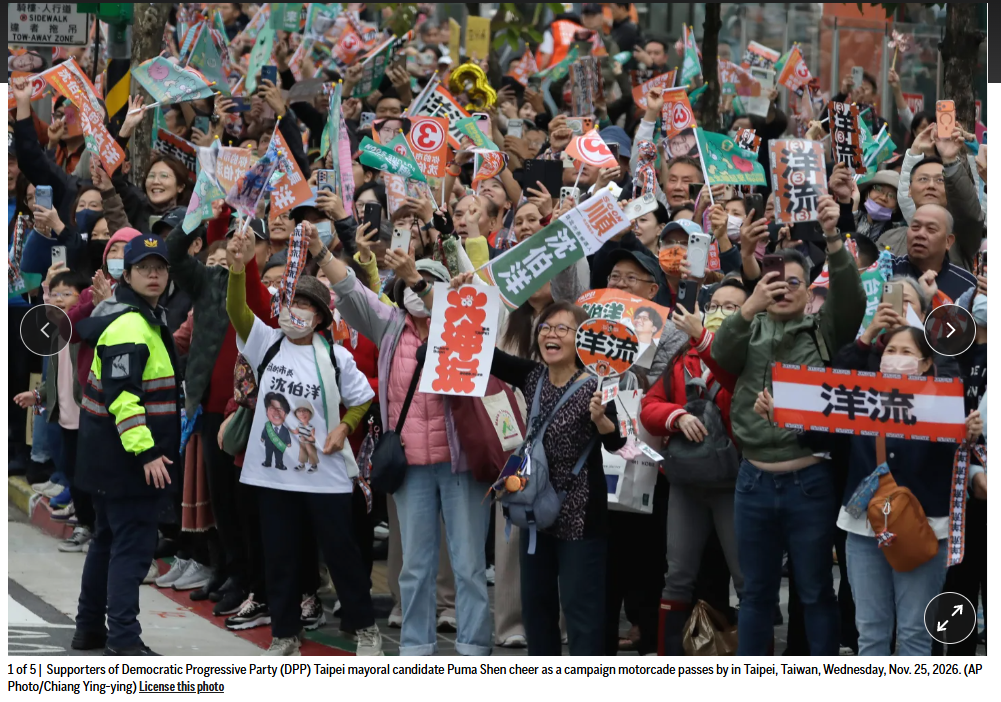
The performance of the other Taipei mayoral candidate, Puma Shen, may also have significant implications for the ruling DPP.
Shen has in the past been very vocal about his strong pro-Taiwan independence stance, declaring that Taiwan is an independent country from China. If elected mayor, Liu said, “he’ll become a very important political figure in the DPP, and he’d push the party’s position more towards independence.”
China looms in the background nonetheless
Looming over Taiwan’s elections are Chinese influence attempts, which have included efforts to sow distrust in the electoral system.
Taiwan’s Mainland Affairs Council on Monday again warned the public to be conscious of any disinformation manipulations ahead of the elections, saying that China’s artificial intelligence tech had made its methods of infiltration increasingly sophisticated.
The deputy head of the council, Shen Yu-chung, pointed to a recent case where prosecutors were bringing charges against a TPP city council candidate for allegedly taking photos of Taiwanese people and using their faces to create fake accounts for online support, with assistance from China.
Chung said China has a very strong incentive to influence any kind of political outcome in Taiwan, and this incentive has not weakened in this election. However, Taiwan has also learned to adapt, he said.
“They have been developing some antibodies on the disinformation attempts and also other kinds of infiltration attempts,” Chung said, pointing to arrests over suspected breaches of the anti-infiltration act.