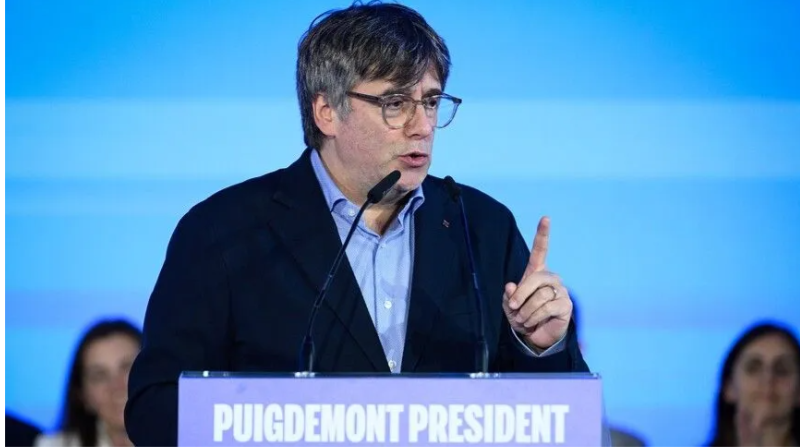
Spain’s Supreme Court granted amnesty to former Catalan President Carles Puigdemont on Monday, closing the criminal case over his failed 2017 independence bid.
The ruling also covers former Catalan ministers Toni Comin and Lluis Puig, ending proceedings against the three over alleged misuse of public funds during the independence drive.
It follows a Constitutional Court decision requiring the amnesty to cover those offenses. Their arrest warrants had already been lifted in October.
Puigdemont responded by sharing a Catalan poem addressed to his “dear enemies,” welcoming their growing numbers and thanking them for fueling his defiance. It ends with a vulgar insult.
Jordi Turull, secretary-general of Puigdemont’s pro-independence Junts party, described the amnesty as a victory over the Spanish state, whether governed by the center-right People’s Party (PP) or the Socialists.
Turull said Puigdemont was expected to return after Sunday’s election. The former Catalan leader is expected to outline his plans at a news conference in Brussels on Wednesday.
Days ahead of elections
PP leader Alberto Nunez Feijoo reiterated that he would repeal the amnesty law if he wins power in Sunday’s election.
“Will I repeal the amnesty law? Yes, because it is a political commitment and political commitments are fulfilled,” he told broadcaster Antena 3.
However, repeal would not undo amnesties already granted.
Catalan President Salvador Illa, a Socialist, defended the amnesty as part of efforts to normalize relations.
“You cannot be prime minister of Spain if you do not understand Catalonia, and every time you speak you show that you do not,” he said, addressing Feijoo.
Despite living in Belgium, Puigdemont has remained a central figure in Spanish politics. Junts’ seven lawmakers helped secure Prime Minister Pedro Sanchez another term in 2023 in exchange for a commitment to pursue the amnesty.
In an interview published by El Mundo last week, Puigdemont said Junts had “taken advantage of Sanchez’s ambition to defeat Spain,” remarks seized on by right-wing parties.
The exchange has renewed scrutiny of what Sanchez might offer separatist parties if he again needs their support to govern.
Sanchez said Sunday that he would not authorize a Catalan independence referendum, arguing that Spain’s Constitution does not permit it. Feijoo dismissed that assurance, noting that Sanchez had also opposed an amnesty before the 2023 election.
At the same time, polls suggest Junts could lose ground in the election, with a 40dB survey projecting four seats for the party, down from seven in 2023.