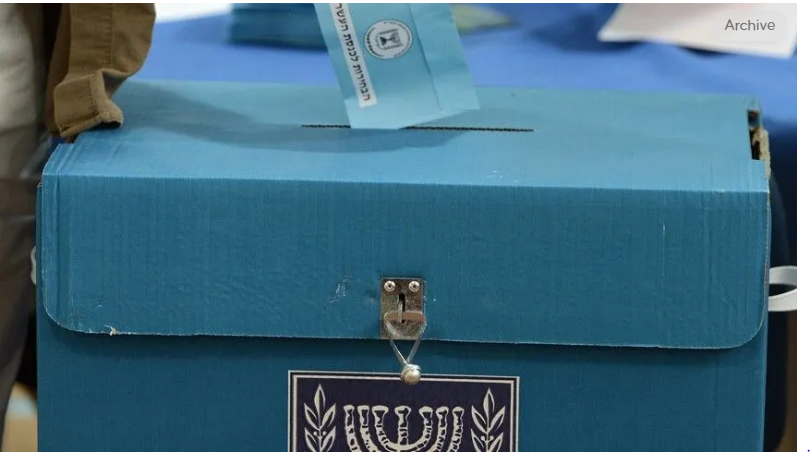
Amid fears over hardline Israeli policies, Palestinian citizens of Israel see the upcoming Israeli elections as a chance for change, with calls for higher Arab turnout to prevent incumbent Israeli Prime Minister Benjamin Netanyahu from forming another government.
In a series of field interviews conducted by Anadolu on the streets of various Arab cities and towns in Israel, citizens emphasized that participating in this election is particularly crucial, given the "worsening racism and marginalization" against them.
While some plan to vote for the first time in hopes of bringing about political change, others continue to abstain, questioning whether elections can alter their circumstances and arguing that successive governments have failed to address their demands.
Arab citizens make up around 20% of Israel’s population of more than 10 million.
Many say they have faced discrimination for years, but view the current government as a more dangerous phase, strengthening their desire to replace it through the ballot box.
Polls suggest Arab parties could win around 15 seats in the 120-member Knesset, while Arab politicians hope higher turnout will weaken the chances of small right-wing parties seeking to support Netanyahu.
Calls for participation, change
Palestinian Imad Bashnaq said the upcoming election was “decisive and extremely important,” particularly for Arab society.
He argued that the rise in racism and fascism since Oct. 7, 2023, had made conditions intolerable.
"I have always maintained that we -- as Arabic speakers -- are the only ones capable of bringing about change in the Middle East, not just here within this country," Bashnaq said, arguing that "a few madmen" have taken control of the government and now seek to dictate the course of an entire region.
“We are the original rightful owners, and there is no dispute about that.
"But we are a minority in a state, and this state is a reality we have to deal with,” he added.
'Every vote makes difference'
Areen Ghanayem said she would vote for the second time, maintaining that “every vote makes a difference.”
She said Arab society needed broad participation given the problems it faces and what she described as the government’s failure to pay sufficient attention to its concerns.
“We need to have a voice and someone who speaks on our behalf and demands the rights that should be ours,” she said.
Ghanayem expressed concern that the current government could return to power, saying it marginalized Arab society.
Citizens, she added, did not want to feel excluded from political life but sought to assert their presence and ability to influence decisions.
Occupier attacks
Mohammed Ahmad Abboud said he would take part in the upcoming election, as he had in the past, with the aim of “removing the racist government.”
He said the current election differed from previous ones because of what he described as “escalating violations,” pointing to Israeli occupiers' attacks in the occupied West Bank.
Abboud also voiced concern over statements by Israeli Finance Minister Bezalel Smotrich regarding the "Judaization" of the Negev and the Galilee -- regions located in the south and north of Israel, respectively.
Occupier attacks against Palestinians in the occupied West Bank have escalated since Israel launched its genocidal war on the Gaza Strip in October 2023.
The attacks have included the killing of Palestinians, the burning of homes, vehicles, and mosques, the destruction of agricultural land, preventing farmers from reaching their land, and the forced displacement of Palestinian communities.
These attacks have coincided with Israeli military operations involving arrests, the demolition of Palestinian homes and structures, and the expansion of illegal settlements.
Between hope and despair
In the northern city of Acre, a resident known as “Jojo” urged Arab citizens to participate in the election, arguing that voting was necessary to bring about change.
“We must vote to bring about change — real change,” he said, expressing optimism that the upcoming election could produce better results.
Separately, Saeed Abu Sultan, also from Acre, said that many years of participating in elections have not brought about any change in the reality faced by citizens.
"Some people might be able to make a difference, but as for us, we’ve grown accustomed to things as they are. We haven’t felt any change for 30 years," Abu Sultan added.
Arab voter turnout expected to rise
Experts expect Palestinian citizens’ participation in the upcoming election to increase compared with the 2022 vote.
Experts and politicians estimate turnout among Palestinian citizens could reach 60% to 61%, up from 53% in 2022, while Arab parties hope participation will rise even further.
Arab politicians say higher turnout could alter the balance of power and reduce the chances of small Israeli right-wing parties crossing the electoral threshold and entering parliament, potentially weakening Netanyahu’s ability to form a government.
The Joint List, comprising the Democratic Front for Peace and Equality, the Arab Movement for Change, and the Balad party, is contesting the election under the leadership of Yousef Jabareen. Polls project it could win nine seats.
The United Arab List, led by Mansour Abbas, is also running, with projections suggesting it could win between five and six seats.
The election is scheduled for Tuesday, Oct. 27, to choose the 120 members of the Knesset, with Netanyahu’s bloc competing primarily against the Jewish opposition parties led by Gadi Eisenkot.
The election comes as Netanyahu’s bloc has been losing ground in opinion polls.
Forming a government in Israel requires the support of at least 61 of the Knesset’s 120 members.
Cooperation between the Jewish opposition and Arab parties could prevent Netanyahu from forming a government.
However, most opposition leaders reject such cooperation, while Netanyahu and Eisenkot have so far also ruled out alliances with Arab parties.
Arab lawmakers have outlined conditions for supporting any government, including ending wars, advancing a political process with the Palestinians, and ending discrimination against Palestinian citizens of Israel.