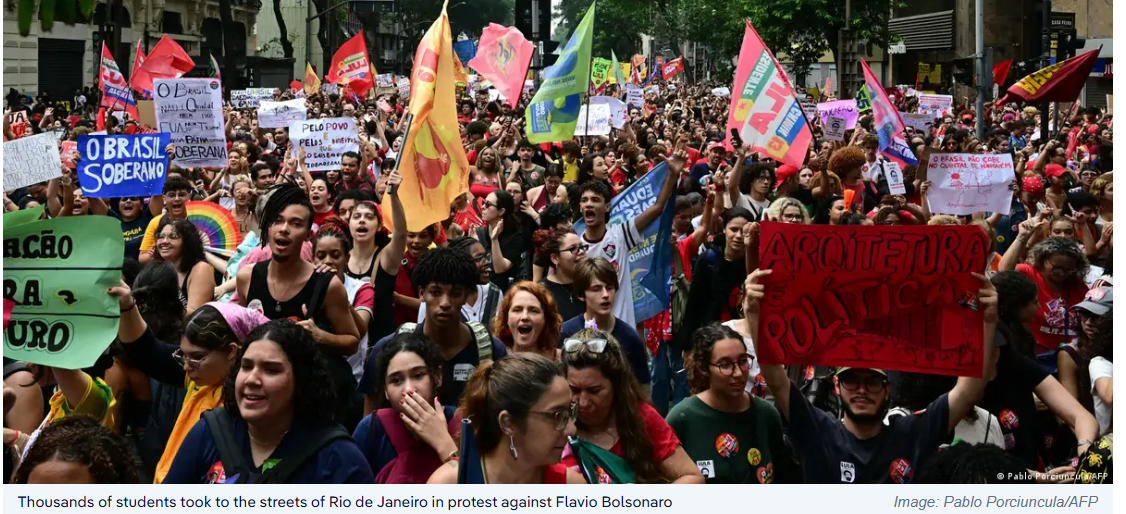
Thousands of people joined a student march in Rio de Janeiro, Brazil, on Wednesday to protest the possibility that Flavio Bolsonaro could become president after the far-right candidate came out on top in the first round of the country's presidential election on Sunday.
Bolsonaro, the son of jailed former President Jair Bolsonaro, won about 2 million more votes than the incumbent president, the left-leaning Lula da Silva.
But since neither reached the 50% hurdle to win the presidency, the pair will face off in a run-off on October 25, in which Bolsonaro is considered the favorite.
"If Bolsonaro wins, Brazil will become a colony of the United States," said 20-year-old literature student Joao Victor Vieira, voicing the fear of many on the left in Brazil that Bolsonaro is too ideologically aligned with US President Donald Trump.
Brazil: 'Never again Bolsonaro'
Other marchers held signs with messages such as "Brazil isn't anyone's backyard," "I don't vote for someone who sells Brazil," and "Never again Bolsonaro" – all against a soundtrack of drums, fireworks and chants.
"We're fighting for Brazil, not for Lula," said Talita Amaral, a 19-year-old environmental sciences student, wearing Brazil's iconic yellow and green football shirt, often worn by nationalist Bolsonaro supporters but which opponents have been aiming to reclaim for themselves.
"We don't have time to be sad, we need to be doing this, occupying the streets, sending messages in WhatsApp groups, trying to convince people," she told the Associated Press.
For Alice Carneiro, a 25-year-old maritime shipping administrator, the prospect of another Bolsonaro conjures fears of far-right policies which will discriminate against Brazil's minorities – such as her transgender wife.
"I'm here because I believe in democracy," she told the AFP news agency. "Because I'm scared."
Witnesses reported that the march was notably more crowded and animated than President Lula's rally on the same street on Friday, the culmination of a lackluster campaign ahead of the election.
After the third, fourth and fifth places all went to right-wing candidates, who polled over eight million votes between them, Lula and the left appear to have a mountain to climb in the run-off.
The incumbent's campaign has shifted its focus to social media, where the far-right dominates but Lula has largely been absent, arguing he "like[s] to say only what is essential." But on Wednesday, the president convened leftist influencers who won legislative seats on Sunday to advise his campaign.