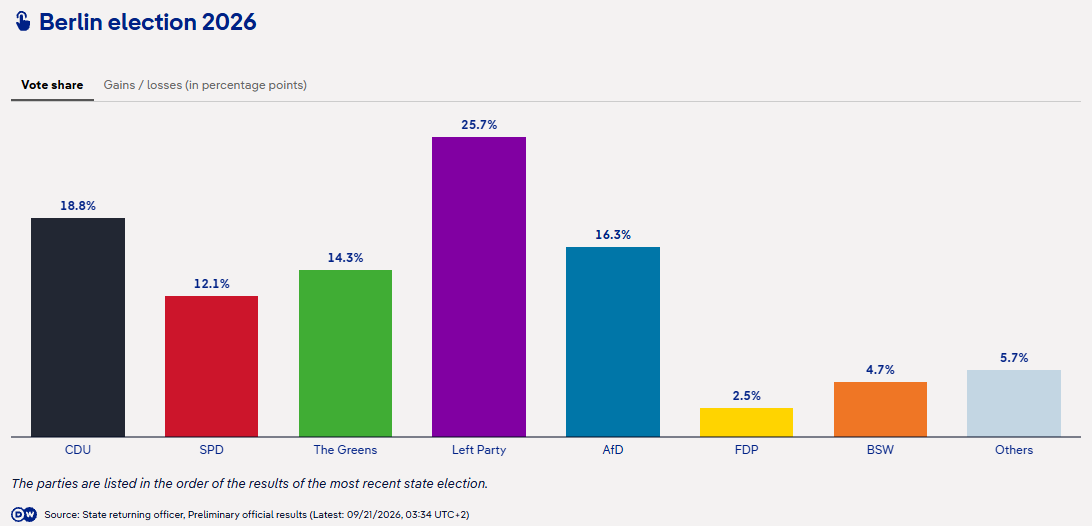
The emphatic victory for the Left Party in last Sunday's state election in Berlin may not have been quite so emphatic if it hadn't been for a significant new rule: This was the first state election in the German capital's history where the voting age had been lowered from 18 to 16.
The actual change was relatively small: It only added around 55,000 voters to the city's electorate of 2.5 million, but it was massively significant to young people themselves: "Of course we talk a lot about politics at school or among our friends," 17-year-old Cecilia told DW's Franziska Wüst on the street outside her school in Berlin on Monday. "We're all very politically engaged; we go to a lot of demos."
Young socialists
That spirit of protest appears to have been reflected in young Berliners' voting habits. While the official exit poll statistics from infratest-dimap don't isolate under-18s, the age-group breakdowns suggest that the Left Party's voters (some 1 in 4 of Berlin voters) skew young. Some 43% of 16-24-year-olds voted for the socialist party — a huge 25-point leap on the last state election in 2023.
That makes sense to 17-year-old Liska, who voted for the socialists: "The Left Party did appeal to me, especially because of the social issues — getting prices down, making rents more affordable." Rents in Berlin are indeed rising at a massive pace — by some 7% in the last two years alone — and first-time tenants are likely to be the hardest hit. Polls also showed that by far the biggest proportion of Berlin voters — 37% — thought that the Left Party was the most likely to create affordable housing.
Cecilia also agreed that rents, as well as the conservative Berlin government's plans to cut education budgets, were the overwhelming concerns among her friends. "We're all getting to an age where we'd kind of like to move out, which in Berlin is almost impossible," she said. "Otherwise, of course it's issues like school, education, so it doesn't get cut everywhere."
Young radicals?
All those answers make a lot of sense to Kathrin Fehse of the German Children's and Youth Foundation (DKJS), which represents the interests of Germany's young people. "It's all the issues that affect them personally," she told DW. "And for that they need to be taken seriously and asked. And the Left Party was one of the parties that mobilized a lot of non-voters, not just young voters — they're people that politicians were not addressing before."
Throughout the campaign, the Left Party had been portrayed as dangerous radicals by the Christian Democratic Union (CDU), the party of the incumbent mayor, Kai Wegner — regardless of how true this is or isn't, it did not appear to scare off young voters.
Some argue that young people are more likely to vote for the radical ends of the political spectrum. Cecilia can see that point: "I think that it's generally true that young people are always a lot more extreme than the older generations, and I do see that too, that it's always very extreme opinions," she said.
But there's also evidence that this is something of a stereotype: infratest-dimap statistics show that the biggest age group for the Left Party were the 25-34-year-olds (some 49% of the vote), while the biggest age group for the far-right Alternative for Germany (AfD) in the Berlin election were 60-69-year-olds (23%). By comparison, only 12% of 16-24-year-old Berlin voters opted for the AfD.
What do young people want?
Gefjon Off, a political scientist who has researched the voting habits of younger generations, said that while it might be generally the case that younger people have more "radical" opinions than older people, the statistical evidence shows that middle-aged men vote for the AfD more than young men. People's age, in other words, "doesn't mean that they are more likely to vote for anti-democratic parties," she said.
What characterizes young voters is not so much radical views, argued Off, but their looser affiliation to any particular party: "In the federal election in 2021, for example, climate protection was a huge issue, and a lot of young people voted for the Greens as the climate was their issue," she told DW. "In this election, affordable housing was a huge issue for the Left Party. That means young people vote more according to issues, and [find it ]easier to move from one party to another."
Off also thinks that young people are less scared off by the stigmatization around the Left Party that still hangs round older generations who associate it with the communist dictatorship of East Germany.
Fehse said that in the DKJS' own study on young people's opinions, named VoiceUp, was that "young people want solidarity, participation, positive prospects for their future, and at the same time they experience these things much too seldom."
She concluded that "at the end of the day, those experiences create the social context in which their political decisions are made."