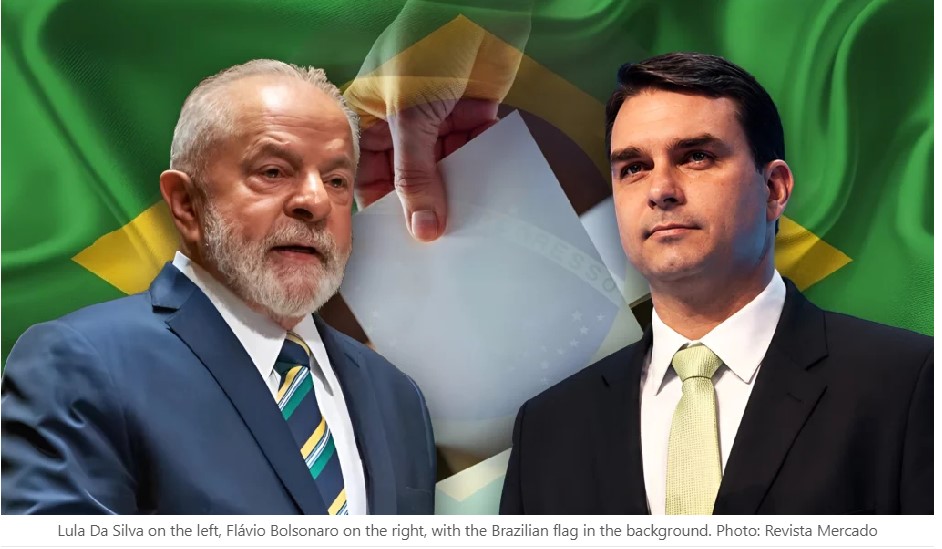
As Lula da Silva and Flávio Bolsonaro prepare for a tight contest, voters face stark choices on state spending, public security, and global alliances.
As Brazil approaches its general election on October 4, 2026, voters face a choice between two distinct political trajectories and visions for Latin America’s largest economy.
President Luiz Inácio Lula da Silva, seeking a fourth nonconsecutive term at age 80, represents the left and social-democratic coalition centered on the Workers’ Party (PT).
Opposing him is Senator Flávio Bolsonaro, 45, who was formally nominated by the Liberal Party (PL) in July, following the judicial disqualification and conviction of his father, former President Jair Bolsonaro.
Recent electoral data indicates a competitive race. An August 2026 poll shows Lula leading first-round voter intentions with 40 percent compared to Flávio Bolsonaro’s 35 percent, while runoff scenarios place the two candidates within a narrow margin of 47 percent to 44 percent.
Understanding this presidential contest requires examining both candidates‘ backgrounds, policy programs, institutional philosophies, and foreign policy stances.
Lula da Silva: From Metalworker to Four-Term President
Luiz Inácio Lula da Silva was born into an impoverished rural family that migrated to São Paulo state. Leaving school to work as a metalworker, Lula rose through the trade union movement during the late 1970s.
As president of the Metalworkers’ Union of São Bernardo do Campo and Diadema, he led major labor strikes that directly challenged Brazil’s military dictatorship (1964–1985). These strikes catalyzed the founding of the Workers’ Party (PT) in 1980 and the Unified Workers’ Central (CUT) in 1983.
Lula entered institutional politics during Brazil’s democratic transition, serving as a federal deputy representing São Paulo in the 1986 Constituent Assembly. After losing three consecutive presidential bids in 1989, 1994, and 1998, Lula moderated his coalition strategy and won the presidency in 2002.
During Lula’s first two terms (2003–2010), his administration implemented poverty-alleviation programs such as Bolsa Família, expanded access to higher education, and oversaw economic growth driven by rising global commodity demand and domestic consumption.
In 2017, as part of the Operation Lava Jato corruption investigation, he was convicted of corruption and money laundering, resulting in 580 days of imprisonment between 2018 and 2019. In March 2021, Brazil’s Supreme Federal Court (STF) annulled all convictions against Lula, ruling that the presiding judge lacked territorial jurisdiction and had demonstrated judicial bias. The restoration of his political rights enabled Lula to return to active politics, winning the 2022 presidential election against incumbent Jair Bolsonaro with 50.9 percent of the valid vote.
Flávio Bolsonaro: From Regional Legislator to Heir of Bolsonarism
Flávio Nantes Bolsonaro was born in 1981 in Resende, Rio de Janeiro. The eldest son of former army captain Jair Bolsonaro, Flávio’s political trajectory developed within the conservative regional machinery of Rio de Janeiro state.
Educated in law at the Candido Mendes University, Flávio entered public office at age 21, winning a seat in the Legislative Assembly of the State of Rio de Janeiro (ALERJ) in 2002.
During his four terms as a state deputy (2003–2019), Flávio Bolsonaro aligned himself with police corporatism, public safety measures, and social conservatism. Flávio advocated for expanding legal protections for law enforcement officers during service and opposed state-level penal reforms.
In 2018, capitalizing on the nationwide wave of support for his father’s presidential bid, Flávio was elected to the Federal Senate representing the state of Rio de Janeiro under the Social Liberal Party (PSL) ticket, before joining the Liberal Party (PL) alongside his family.
Following Jair Bolsonaro’s 2022 election defeat, subsequent judicial disqualification by the Superior Electoral Court (TSE), and subsequent criminal sentencing for his role in anti-democratic plots, the Liberal Party designated Flávio to lead the conservative ticket in 2026. At the party convention in São Paulo on July 25, 2026, Flávio formally accepted the nomination, declaring to supporters: “I may be calmer, more cheerful, more composed, and more moderate, but Bolsonaro blood flows here”.
Socio-Economic Models – State-Led Development vs. Market Deregulation
Brazil’s 2026 political debate pits two sharply contrasting economic visions against each other. Lula’s platform centers on direct state involvement in strategic sectors and sustained social spending, anchored in the New Growth Acceleration Program (Novo PAC), which channels public and private investment into infrastructure, energy transition, transport, and urban sanitation.
On the social front, Lula’s administration expanded Bolsa Família, restored annual real increases to the minimum wage above inflation, and helped reduce extreme poverty during his third term while pursuing a gradual fiscal adjustment that combines tax reform with public investment in healthcare, education, and housing under My Home, My Life.
By contrast, Flávio Bolsonaro advocates an economic model built on market deregulation, fiscal austerity, and reduced state intervention, aligning with the conservative movement led by his father, and prioritizing agribusiness, finance, and commercial sectors.
Flávio’s program emphasizes cutting public spending, lowering corporate taxes, and reducing administrative burdens to attract foreign direct investment, while supporting the privatization of remaining state-controlled assets because private management improves efficiency and curbs corruption.
Flávio’s agenda also calls for weakening environmental licensing and labor regulations, especially for large-scale agriculture in the Center-West and Amazon, core parts of his electoral base.
Foreign Policy and Geopolitics: Multipolar Autonomy vs. Washington Alignment
Lula’s approach is grounded in active non-alignment and South-South cooperation, emphasizing regional integration through CELAC and UNASUR and deepening ties within the expanded BRICS+ coalition alongside China, India, Russia, South Africa, and new member states.
During his 2026 campaign, Lula explicitly rejected foreign interference in domestic policy, telling supporters, “In Brazil, we do not accept anyone sticking their nose where it does not belong,” a stance that hardened amid trade disputes with Washington, including U.S. tariffs on Brazilian exports and diplomatic friction with the Trump administration.
Lula’s diplomatic strategy seeks to balance relations with major powers while resisting unilateral sanctions or trade constraints, supporting the use of local currencies in international trade to reduce dependence on the U.S. dollar and positioning Brazil as a key negotiator in climate summits.
By contrast, Flávio Bolsonaro advocates explicit diplomatic and strategic alignment with the United States, placing Brazil within a Western-centric framework and reprising his father’s playbook of prioritizing bilateral ties with conservative governments and figures such as U.S. President Donald Trump, Argentine President Javier Milei, and Israeli Prime Minister Benjamin Netanyahu.
In May 2026, Flávio made an unofficial visit to Washington, D.C., meeting with Trump and Secretary of State Marco Rubio to propose closer security and economic ties, including Brazil’s entry into the U.S.-led “Shield of the Americas” regional security initiative and the designation of major Brazilian organized crime groups as international terrorist organizations under U.S. frameworks.
State Security, Democracy, and Human Rights
Public security has emerged as a pillar of Senator Flávio Bolsonaro’s 2026 presidential platform. In June 2026, Flávio presented his comprehensive public safety proposal titled “Brazil Without Fear” in São Paulo’s financial district.
The plan draws on the security model implemented by Salvadoran President Nayib Bukele, emphasizing hyper-incarceration, expanded law enforcement powers, and strict penal measures.
A primary component of the “Brazil Without Fear” initiative is the construction of five maximum-security prison complexes. The candidate proposes naming the expanded complex “Gloom”, explicitly stating that the goal is to shift fear from citizens to criminal offenders.
Flávio’s plan further proposes lowering the age of criminal responsibility from 18 to 16, introducing chemical castration for violent sexual offenders, and deploying Navy forces to major national ports to intercept cocaine exports.
To address organized crime, Flávio advocates classifying major domestic criminal factions, such as the Capital’s First Command (Primeiro Comando da Capital) and Red Command (Comando Vermelho), as “narco-terrorist organizations” under national law and international agreements.
In contrast, President Lula da Silva’s security and human rights framework centers on institutional democratic governance, social crime prevention, and the protection of vulnerable and Indigenous populations.
Following his return to the presidency in 2023, Lula prioritized rebuilding federal institutions after the January 8 attacks on the Presidential Palace, Congress, and Supreme Court, placing a strong emphasis on constitutional norms and civilian oversight over the armed forces.
Lula’s administration has tied public safety directly to social development, arguing that long-term security requires public investments in education, youth employment, and urban infrastructure alongside intelligence-led policing.
The Ministry of Justice and Public Security under Lula has focused on dismantling the financial networks of criminal organizations rather than relying solely on confrontation in urban neighborhoods.
Lula’s platform opposes proposals to lower the age of criminal responsibility, emphasizing the reform of the youth socio-educational system and stricter regulations on private firearm ownership, reversing the gun-decontrol decrees issued during the previous administration.
Lula’s government restored federal operations to protect Indigenous territories, notably leading emergency humanitarian and security deployments in Yanomami lands to expel illegal gold miners. Lula’s administration expanded the mandate of the Ministry of Indigenous Peoples and the Ministry of Racial Equality, strengthening constitutional protections for land rights, traditional communities, and civil liberties.
The Historical Horizon of Brazilian Democracy
The 2026 general election represents a historic crossroads for Brazil, bringing into sharp relief two fundamentally incompatible trajectories for the nation’s socio-economic and political future.
The choice between Luiz Inácio Lula da Silva and Flávio Bolsonaro reflects a deeper contest between competing models of statecraft, institutional governance, and global positioning.
As October 2026 approaches, the outcome of this presidential contest will extend well beyond domestic administration. It will determine Brazil’s role in international climate negotiations, the trajectory of regional integration across Latin America, the stability of its democratic institutions, and the economic distribution of wealth for its citizens.