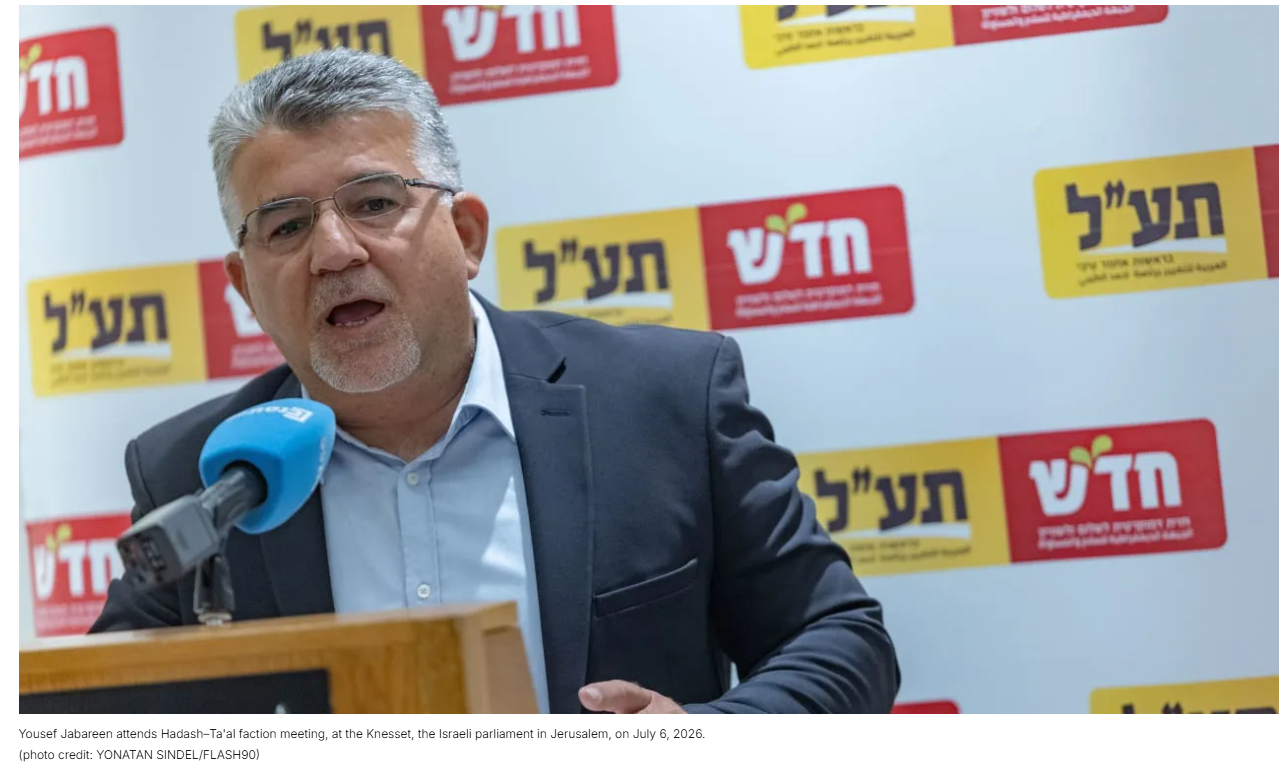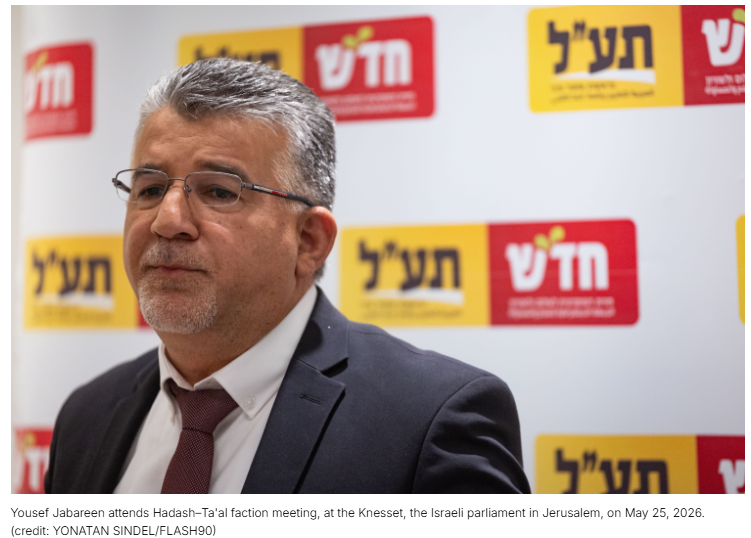
Three of the four major Arab parties, Hadash, Ta’al and Balad, are expected to officially revive the Joint List this week without Ra’am, while also unveiling their new Knesset slate, Hadash-Ta’al’s recently appointed chairman Yousef Jabareen told The Jerusalem Post in a Monday interview.
Jabareen will lead the party’s list, having replaced longtime party leader Ayman Odeh, after primaries for Hadash in May.
The alliance without the Ra’am Party, led by MK Mansour Abbas, marks a setback in efforts to reunite all major Arab parties under a single electoral slate.
Jabareen told the Post that the door was still open for Ra’am to join ahead of the elections, scheduled to take place on October 27.
Polls have shown that if the Arab parties run together, they will obtain more seats than in separate runs.
Until this week, Hadash, Ta’al, and Balad had been negotiating the order of the reestablished Knesset slate, navigating “certain difficulties that arose over the parties’ demands,” Jabareen explained.
To settle the differences, the parties met with the Consensus Committee that helped to establish the Joint List in 2015.
Jabareen said the parties empowered the committee to determine the final makeup of the slate, in order to avoid prolonging negotiations.
“We gave them authorization to propose the composition of the list, simply to shorten the timeline and not continue negotiations,” he said.
Committee expected to complete work by end of week
According to Jabareen, the committee is expected to complete its work by the end of the week.
“Immediately afterward, all the parties will announce that they accept the decision and officially launch the Joint List,” he explained.
Various agreements have been made regarding the first slots on the list, he also noted.
The joint list bloc, originally made up of the four parties, began to break apart ahead of the 2021 elections after Ra’am left the alliance. Then, in a dramatic last-minute split in 2022, Balad broke off from the two remaining factions and filed a separate list.
Currently, the two Arab-Israeli parties in the Knesset are Ra’am and Hadash-Ta’al. The latter is a reduced Joint List that agreed to run together in the 2022 election.
The Balad Party, not in the Knesset, continues to fail to pass the electoral threshold in polls.
Regarding the relations with Abbas, Jabareen said that there were currently no ongoing negotiations with Ra’am to join the new Joint List.
Jabareen noted that Ra’am had said it would only consider renewing negotiations closer to the deadline for submitting party lists.
“We don’t want to wait until then. Therefore, we moved forward. And we are moving forward with forming a list of the three parties,” Jabareen explained.
Asked whether Ra’am’s decision not to join the alliance would hurt the newly reestablished Joint List, Jabareen acknowledged it would make the campaign more challenging, but he said he remained confident that the alliance could succeed.
“It is not on us. In general, one Joint List in Arab society was supposed to bring very high voting rates, relatively speaking, because all the time voting rates have been lower than in Jewish society.
“If there are two lists, the three-party list on one side and Ra’am on the other, we will have to work harder to bring people to the polling stations.
“It is possible, and I hope we succeed, but this will be a more difficult task than if there were one list,” Jabareen said.
Joint List aims to remove PM Netanyahu from gov't
He emphasized that a main objective of the party would be to replace the current government and remove Prime Minister Benjamin Netanyahu from government.
“Our top priority is simply sending the current government home,” he said. “This government is very dangerous, and it basically threatens the basic rights of the Arab public.”
Jabareen said that the Arab public has been “under a very serious attack, from racist laws, policies of home demolitions, land confiscation, failure to transfer budgets to local authorities, policies of silencing freedom of expression, false arrests, harassment of Arab youth – of course in addition to the war in Gaza, the war, harassment in the West Bank, settler terrorism in the West Bank.”
Regarding potential cooperation with opposition figures, including Yashar party leader Gadi Eisenkot and former prime minister Naftali Bennett, who leads the Together party, Jabareen said any future support for an alternative government would depend on negotiations over the party’s key demands.
“Everything will depend on the willingness to negotiate with us on issues that align with our political principles,” he said.
Jabareen said that the new Joint List would be pushing for the establishment of a Palestinian State.
“We want to see renewed negotiations with the leadership of the Palestinian people, in order to advance the process of establishing a Palestinian state alongside Israel.”
Other priorities for the party include advancing equality for Arab citizens and combating organized crime in Arab communities amid rising violent crime, Jabareen said.
“We want a commitment to advancing a policy of equality for Arab citizens.
“We want to see a plan to fight crime organizations in Arab society, to eradicate crime.
“We of course want to see budgets for the severe hardships in Arab society, and support for local authorities,” he added.
Regarding Ra’am’s decision to run separately, Jabareen said he hoped that if the two parties competed in the election, it would be done “in a good atmosphere and without personal attacks.”