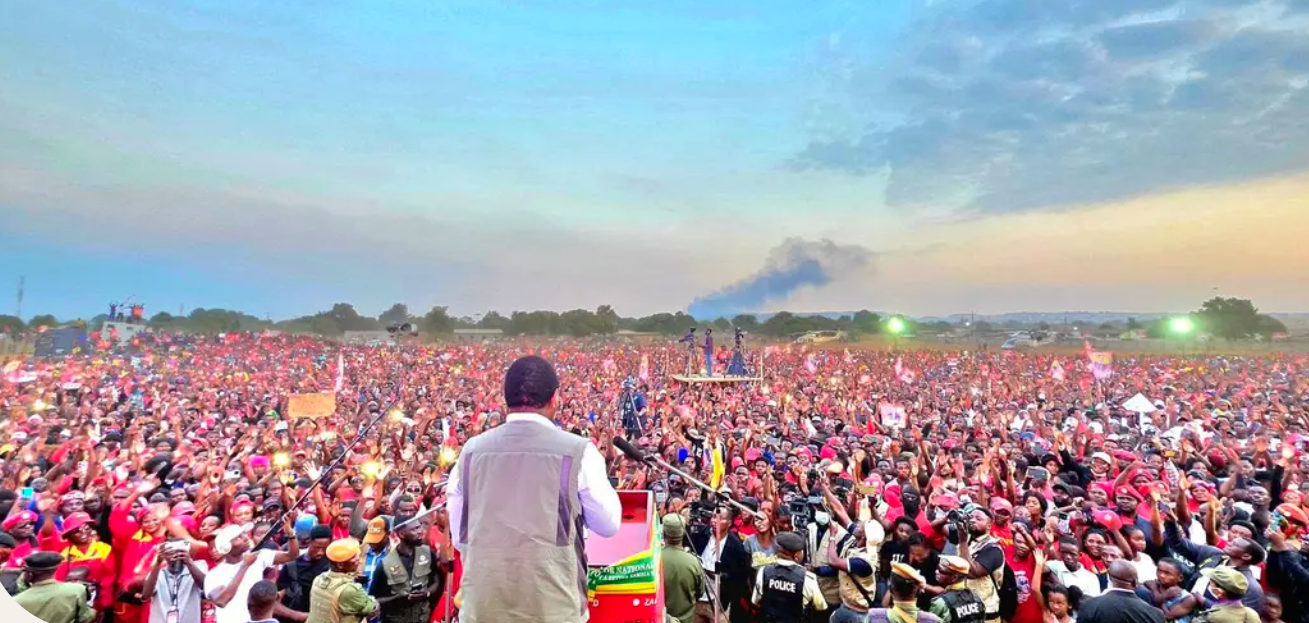
Fourteen candidates have lined up but in reality, the contest is between the UPND's Hakainde Hichilema and Tonse Alliance's Brian Mundubile
Zambia heads to a general election on 13 August, with incumbent Hakainde Hichilema expected to secure a second term.But the opposition is seeking to turn voter frustration over the high cost of living into a campaign against the incumbent.
Fourteen candidates have lined up but in reality, it is a two-horse race between Hichilema of the United Party for National Development (UPND) and Brian Mundubile of the Tonse Alliance (TA), a faction that emerged out of the former ruling Patriotic Front (PF) which lost power to UPND in 2021.
Hichilema, 64, who has maintained his Vice-President Mutale Nalumango as running mate, enters the election with the advantages and challenges of incumbency while benefiting from a weak opposition.His five years in office have enabled him to make inroads into former PF strongholds by capitalising on and integrating the party's once-formidable political structures into his own.
Frustrated by infighting in the PF, several senior party figures have defected to Hichilema's camp, complicating the opposition's efforts to reclaim its heartlands.Until May, Hichilema appeared headed for a relatively unchallenged re-election.However, the opposition has shown signs of regaining momentum.Leading the TA is Mundubile, 55, a lawyer, accountant, former minister and later government chief whip in Parliament.His running mate is Makebi Zulu, 45, who also serves as spokesperson for the family of the late former president Edgar Lungu.The pair have concentrated the campaign in the northern half of the country, seeking to revive the fortunes of the former ruling party in its strongholds.Their task is to reunite a fractured opposition and rebuild the coalition that brought the PF to power in 2011.
The remaining contestants are barely visible.The campaign of former foreign affairs minister Harry Kalaba, 50, who finished third in the 2021 election, has been overshadowed by the more crowd-pulling Mundubile.Socialist Party leader Fred M'membe, 67, a former newspaper publisher and journalist, has said his campaign is focused on grassroots mobilisation and has largely avoided the high-profile rallies.
Both sides have sought to project strength through the size and enthusiasm of their campaign crowds.Hichilema's supporters point to the ruling party's ability to draw large gatherings as evidence of an expanded national footprint.The Mundubile camp has used the size of its rallies as proof that it retains a deep grassroots base and public frustration with the government is translating into renewed political vigour.Matters of the stomach
As in 2021, the economy remains the dominant election issue.The election is seen as a referendum on Hichilema's economic reforms.He inherited a country that had defaulted on its external debt, with credit rating agencies having downgraded Zambia to "junk" status.The copper mining industry was also in disarray.
Hichilema says his administration has restructured 94% of Zambia's sovereign debt, reducing annual debt servicing obligations from $2.3 billion (R38bn) to $900 million.He says the $1.4bn in savings is being redirected towards social sectors.
Over the past five years, the government says it has recruited 45 000 teachers, built thousands of new classrooms, introduced free education, bringing 2.5 million more learners into the education system.It also says 18 000 health workers have been hired and several hospitals constructed.Major roads have been paved.More than 1.5 million people are benefiting from the Social Cash Transfer programme.
The government says inflation has fallen from 24% in August 2021, when Hichilema took office, to 6.5% in June 2026.There is resurgence in the mining industry with a reported $12bn in new investment, the exchange rate has stabilised and foreign exchange reserves have increased to $6.5bn.But the opposition argue that macroeconomic gains mean nothing if they don't improve the lives of the people.Mundubile has dismissed the government's macroeconomic story as "big English" while the masses were hungry.He promised that once elected, he would dip into the reserves to resolve what he sees as pressing economic challenges.Supporters cheered him; critics doubted his understanding of economics.
Hichilema and the opposition agree that the cost of living remains unacceptably high but they differ on the reasons.The opposition portrays it as evidence of failed economic management and government incompetence.Hichilema argues that the hardship is a temporary consequence of difficult but necessary reforms.He says his first term was devoted to stabilising the economy and laying the foundations for recovery, while reducing the cost of living is the next phase.The opposition is telling voters that the increased cost of living is enough reason to vote Hichilema out.
Burial politics
The election campaign has also unfolded against the backdrop of a dispute over the burial of the former president.Lungu died in South Africa on 5 June 2025.His death was followed by a battle between his family/party and the Zambian government over his burial.The family insisted that the government play no role in the funeral arrangements.The government argued that Lungu was entitled to a state funeral and burial at the Presidential Burial Site in Lusaka.
The dispute culminated on 23 June 2026, when South Africa's Supreme Court of Appeal ruled in favour of Lungu's family.Many Zambians view the failure to lay a former president to rest more than a year after his death as a national embarrassment.
On the campaign trail, the TA has invoked Lungu's legacy to broaden its electoral appeal.Mundubile has pledged to give Lungu "a dignified burial" if he wins.Such rhetoric has drawn criticism from those who argue that his death and burial have been unnecessarily politicised.
The path to victory
There are 8.7 million registered voters.To win outright, a presidential candidate must secure 50% +1 vote of the valid votes cast.Assuming a turnout of 70%, a candidate would need at least 3 045 001 votes to cross the constitutional threshold.
Hichilema is expected to dominate in his strongholds of Southern, Western and North-Western provinces, which together account for about 2.2 million registered voters.Lusaka and Copperbelt, the country's two largest electoral battlegrounds, have 1.4 million and 1.2 million, respectively.
The opposition is expected to perform strongly in the former PF strongholds of Northern, Muchinga and Luapula where Hichilema has spent the past five years expanding the UPND's presence.To reach the 50%+1 threshold, the opposition will need to maximise turnout in Northern, Muchinga and Luapula and make inroads into Lusaka and the Copperbelt.
The opposition alliance's failure to field parliamentary candidates in 75 of the 226 constituencies deprives its campaign of mobilisation networks in large parts of the country.Overall, Hichilema appears to have more plausible pathways to securing victory than the opposition.