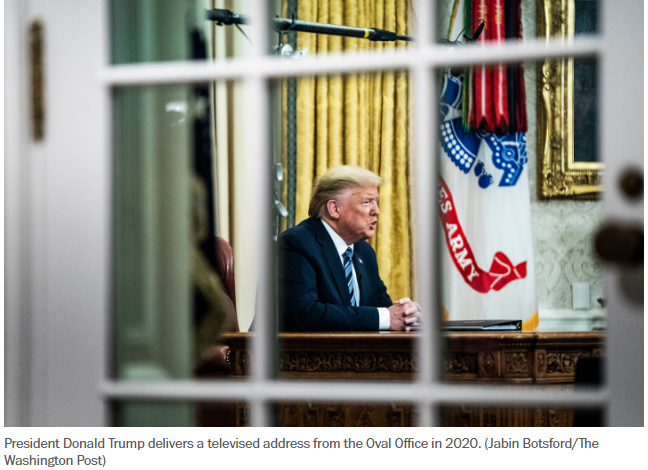
President Donald Trump is planning a prime-time address Thursday that will use findings from reexamined government files to argue that the country’s election infrastructure has vulnerabilities, according to two people briefed on the plan.
Trump told reporters in the Oval Office on Tuesday that the speech would concern voting machines but declined to elaborate. “It will concern that subject, and we’ll have a couple of other things to say, also,” he said. “But I’d rather save it. But it’s really big news.”
The president could use the address to press his long-standing allegations of foreign interference in the 2020 election, the results of which he has never accepted. The speech, in part, will highlight claims that China accessed U.S. voter data, said the people, who spoke on the condition of anonymity to discuss a plan that has not been made public. Trump is also expected to discuss findings related to Venezuela, they said.
It was not clear Tuesday whether the major broadcast networks would provide airtime for the speech. As of late morning Tuesday, the White House had not made a request for air time.
The plans are fluid and could change. “Anonymous sources are speculating about what President Trump will say during his speech on Thursday evening,” White House press secretary Karoline Leavitt said. “The truth is, nobody knows yet what President Trump will ultimately say, which is why everyone should tune in.”
The plan came after a confidential White House briefing on Monday to review findings from the Trump administration’s broad reexamination of old FBI records, including from the 2020 election, one of the people said. Trump then announced the speech on social media, without specifying the subject.
In recent weeks, FBI Director Kash Patel has dispatched hundreds of agents to help the bureau’s Atlanta field office review 700 files by July 17, according to an internal FBI obtained by The Washington Post. Trump has long argued that he unfairly lost the 2020 presidential election in Fulton County, Georgia, which includes Atlanta, and, despite a lack of evidence, the FBI field office has been investigating those claims.
Trump is making the prime-time announcement at the urging of advisers including Bill Pulte, the acting director of national intelligence, and John Solomon, a former conservative journalist who temporarily joined the White House to help review government records for release. Solomon has long questioned investigations surrounding Trump and has pushed for the release of FBI investigatory files related to alleged election interference.
Since Trump returned to office, multiple federal agencies have pursued allegations of tampering with the 2020 vote that had previously been investigated and rejected.
U.S. intelligence agencies concluded in March 2021 that there was no foreign interference that altered votes or manipulated machines in the presidential election. The agencies said Russian and Iranian spies did try to influence Americans. They also said China considered but did not go through with efforts to try to affect the outcome of the election, a finding that was the subject of internal dispute at the time.
In Trump’s second term, the Office of the Director of National Intelligence, under Tulsi Gabbard until last month, has taken steps including examining voting machines used in Puerto Rico looking for cybersecurity vulnerabilities.
In September, the contract firm Mojave Research completed a report for the national intelligence director’s office based on forensic analysis of digital voting software obtained from Puerto Rico. The report concluded that software vulnerabilities made the machines highly vulnerable to hacking, according to two people familiar with the report, who spoke on the condition of anonymity to discuss findings that have not been made public. The Mojave analysts found no evidence that exploitation took place, they said.
The report’s release had been delayed by the White House, the people said, but it could come this week.
In January, the FBI and Justice Department seized 2020 ballots that were preserved by a court order in Fulton County. Investigators also obtained records including ballot images from the Republican-led Arizona Senate’s review of the 2020 results in that state’s largest county. And the FBI in recent months interviewed current and former election officials about the 2020 election in Milwaukee.
Trump lost all three of those swing states in 2020. Recounts and court reviews have upheld those results, even as Trump has spent years falsely claiming the election was rigged.
The Arizona and Georgia investigations came at the instigation of Kurt Olsen, a lawyer who worked on Trump’s efforts to overturn the 2020 results at the time and advised him in the White House in 2025.
Trump has taken a series of actions in recent months aimed at influencing how elections are carried out. Most have been blocked in court or otherwise stymied.
Last week, Trump disbanded a bipartisan commission that helps states and localities administer elections. He also recently signed executive orders designed to limit mail ballots and to require states to verify voters’ citizenship with federal data. Those orders have been halted in court. Judges noted the Constitution gives the power to run elections to the states and Congress, not the president.
The Justice Department has sued to get copies of state voter rolls but so far has lost those cases. And the administration’s efforts to allow states to check voter eligibility in a massive federal database has been severely hampered in a separate case.
Trump has demanded that Congress pass a law to require proof of citizenship and ID to vote in this year’s midterms, but Senate Republicans say they lack enough votes. To escalate the pressure, Trump refused to sign a bipartisan bill aimed at making housing more affordable, allowing the legislation to become law without his signature.
Election officials and voting rights advocates have been bracing for months for the administration to release information that purports to cast doubt on how elections are conducted.
“Few things can be more predictable than this coming,” said Lawrence Norden, vice president of elections and government at the Brennan Center for Justice at New York University, a voting rights organization that has sued the administration over some of its election policies.
Any electronic system has vulnerabilities, but states are vigilant about making sure their outcomes are correct using “layered defenses,” Norden said. States conduct audits and recounts to ensure accuracy, and 98 percent of votes in the midterm elections will be on paper ballots that can be reviewed, he said.
“Unless you have that context of the security that’s already in place, I think some of the kind of things that they’re throwing against the wall can be very confusing to the public,” he said.
Some Trump White House officials in 2020 believed China favored Joe Biden in that year’s election and doubted the intelligence assessment that the country would not seek to interfere and had no preference, according to a former official who spoke on the condition of anonymity because of the matter’s sensitivity.
That view was shared by then-Director of National Intelligence John Ratcliffe, who is currently serving as CIA director.
Ratcliffe “disagreed with the established analytic line on China, insisting ‘we are missing China’s influence in the US and that Chinese actions ARE intended to affect the election.,’” according to a January 2021 report to Congress from an analytic ombudsman for the intelligence community.