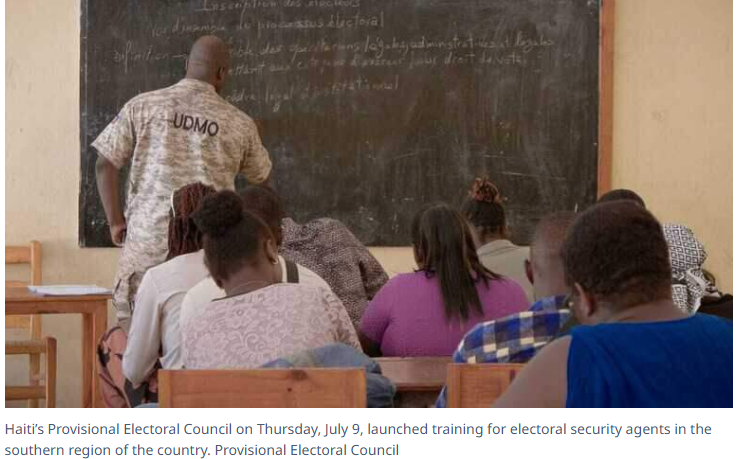
With a record 316 political parties approved to compete in Haiti’s long-delayed general elections, the country’s electoral agency on Friday announced the timetable for voter and political party registration, while encouraging the formation of coalitions in hopes of reducing the fragmented political landscape.
The first nationwide vote in a decade, the elections are expected to be one of the greatest logistical challenges in recent memory. Nearly 1.5 million people remain displaced by gang violence, armed groups continue to control large swaths of the capital and surrounding areas, and the government for the first time plans to allow Haitians living abroad to vote for president.
Under the timetable announced, voter registration will begin July 16. Political parties may register coalitions between July 13-17, and alliances between July 22-27.
To facilitate the process, the electoral agency, the Provisional Electoral Council, will launch an online platform so that parties can register and upload their membership lists. The platform is linked to the National Identification Office database, the council has said, to reduce the risk of fraud through a verification system.
The partial electoral calendar, however, does not include a date set for the first round of voting.
In an interview with the Miami Herald ahead of the publication of the timetable, Prime Minister Alix Fils-Aimé said he expects the electoral council to announce the election date within the next two weeks.
“The electoral council is right in one thing: They are the only ones who have the mandate to do the elections, and doing the elections, they are the only ones also who have the mandate to give the date,” he said, speaking on the sidelines of the Caribbean Community meeting this week in Saint Lucia. “So I’m waiting for them to give me the date. They run the operations, they know how long it will take them, they need to give us that number.”
The major issue remains security, underscored in recent days following another deadly attack the night of July 4-5 in the hills of Port-au-Prince in Kenscoff; Haitians shared on social media a video of a man’s ear being cut off by a gang member. The armed clashes on residents in the West region, which includes metropolitan Port-au-Prince, have left more than 3,000 people newly displaced in the communes of Ganthier and Kenscoff, the United Nations said on Thursday.
On Friday the Norwegian Refugee Council and the U.N.’S International Organization Migration painted a grim picture of the situation on the ground: Port-au-Prince is not just the epicenter of the displacement crisis, but Haitians are also facing growing desperation as deportations take place from the neighboring Dominican Republic; 6.4 million Haitians find themselves in need of humanitarian aid with only 10% of public health facilities fully operational.
“Haiti’s crisis has become deeper, more complex, and more urgent,” Youri Saadallah, the global emergency director for the Norwegian Refugee Council, said.
Speaking to reporters from Port-au-Prince, Saadallah said that during conversations with a number of government ministers on Thursday the issue of electionS did come up and “Their message was extremely clear: Haiti requires a Haitian solution for a Haitian problem and their direction of travel is also very clear.
“They have a road map in place, and they have clear focus area. One is security, the other one is elections,” he said. “We heard that message loud and clear, and we fully respect and listened carefully. At the same time, our work as humanitarian is to alleviate the suffering of the people of Haiti and in support of those efforts. It’s not for us to comment as to whether the elections can or cannot take place. What we do see and what we saw very vividly is that we have to respond to these urgent, urgent needs.”
The ongoing violence and humanitarian needs have prompted concerns about voter disenfranchisement by some human rights and civil society advocates who note that a majority of the electorate live in the West and neighboring Artibonite regions. Fils-Aimé, however, disagrees with this assertion, telling the Herald that “People have moved.”
Still, he acknowledged the importance of having the U.N.-authorized Gang Suppression Force, which welcomed 300 soldiers from Sri Lanka this week, fully deployed before balloting take place.
After clashing over the budget and the electoral law, Fils-Aimé and the electoral council finally agreed on a $120 million budget, down from an initial proposal of $250 million. The government also published a revised electoral decree on July 2 following weeks of tension between the council and prime minister, with the council accusing Fils-Aimé of overstepping his authority by seeking changes in the conditions under which votes are to be cast.
Among the contentious issues were revisions affecting the length of elected mandates, the structure of local governments and the eligibility requirements for candidates and political parties, including a provision requiring parties to have at least 30,000 members to field candidates. While the threshold sparked debate, the decree offers financial incentives for parties to merge by discounting registration fees for coalitions and alliances.