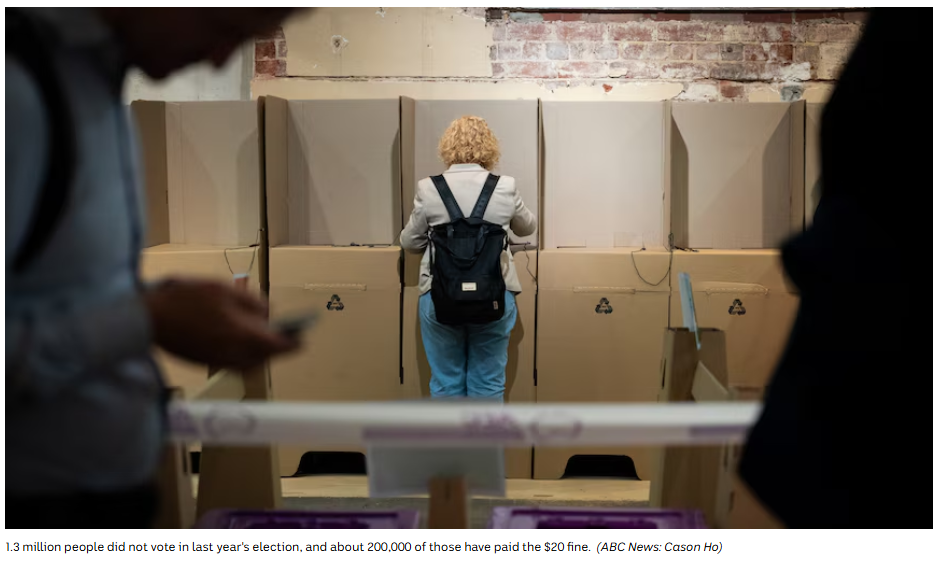
Hundreds of thousands of Australians who failed to cast their vote at last year's federal election have paid millions of dollars in penalties.
The ABC can reveal the Australian Electoral Commission (AEC) dished out "apparent failure to vote" notices to more than 1.3 million people following the 2025 poll.
All enrolled adult Australians must vote in federal and state elections under the nation's compulsory voting policy.
About 90 per cent of eligible Australians voted in the 2025 election.
But those who fail to fulfil their civic duty in elections face a $20 administrative penalty, or they could cop a fine of up to $330 if the matter is referred to court.
As of May, 207,000 people had elected to pay the administrative penalty, which means they have collectively forked out about $4.15 million.
The money from the penalties goes into the federal government's consolidated revenue fund.
Quarter of a million excused from voting
More than 250,000 non-voters, as of June, will not be punished by the AEC after providing a "valid and sufficient" reason for not casting their ballot.
The AEC also confirmed 710,000 electors had not responded to their apparent failure to vote notice by the relevant deadline.
"A failure to respond can of course occur by choice, due to a recent residential move or due to other practical reasons," the election watchdog said in a statement, adding electors may be punished for not providing a valid reason.
"Like all legal matters, we weigh up a number of factors before commencing any action."
The AEC said court action against non-voters had "progressed" and many were finalised, however final figures were not yet available.
Compulsory voting rare around the world
The 1.3 million notices issued for the 2025 poll is similar to the roughly 1.27 million notices given out following the 2022 election.
Australian National University associate professor in politics Jill Sheppard described compulsory voting as a "net good".
"The obvious good is that it gets everyone involved in elections," she said.
"And in Australia that means, even if you feel like the parties don't necessarily speak for you, even if you feel like you're unrepresented by people in Canberra, you still feel engaged with the political process.
"The downside of compulsory voting is that the parties assume that we will always turn out to vote, no matter how boring or how unresponsive or how out of touch they may seem, and that can breed laziness."
Dr Sheppard also pointed out compulsory voting across the world was "so rare" — and said Australians were amongst the most active voters in democratic countries.
"At any given time, less than two dozen countries in the world would have some form compulsory voting," she said.
"To combine compulsory voting with such a liberal democracy is even rarer."
According to the AEC data, the electorate of Durack in Western Australia had the highest number of apparent failure to vote notices, with 20,000 issued.
Rounding out the top five seats with the most non-voters were Leichhardt, Kennedy, Forde, and Herbert — which are all located in Queensland.
The electorate where the smallest number of notices was issued was Franklin in Tasmania, where fewer than 3,500 people did not turn up to the polls.
This was followed by Clark, also in Tasmania, and then Corangamite, Kooyong, and Menzies — all located in Victoria.