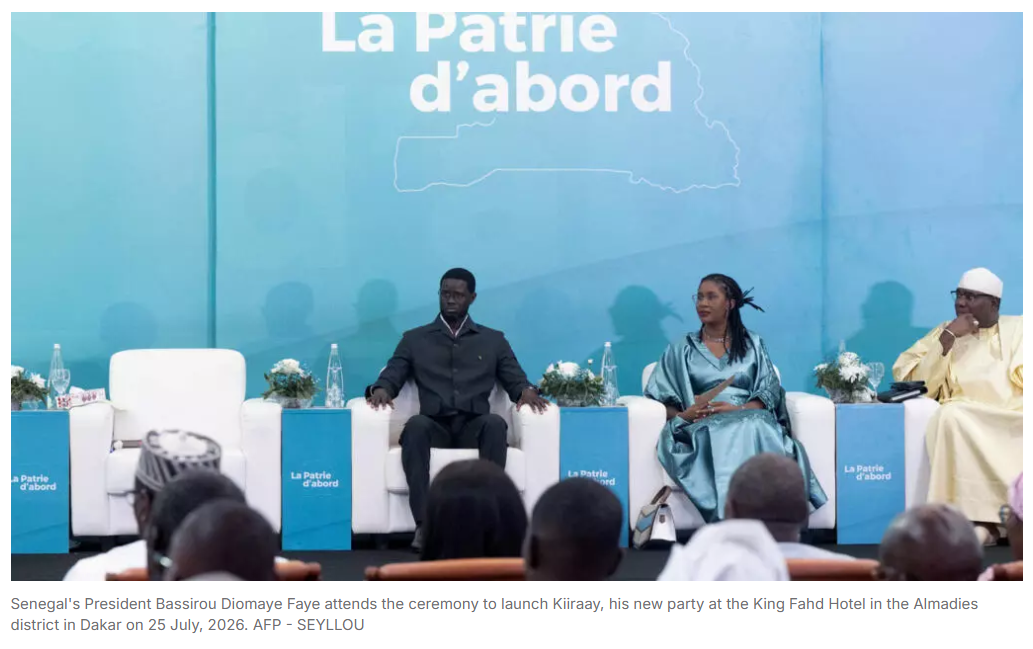
Senegal's President Bassirou Diomaye Faye on Saturday launched a new political party called Kiiraay, following his high-profile falling-out with his former mentor and ex-prime minister, Ousmane Sonko, and his party Pastef.
The Senegalese president unveiled his new party at a gathering in Dakar on Saturday, describing it as "the majority party in this country".
In a packed assembly of hundreds of supporters, those who could not fit inside the hotel conference room waited outside in searing heat, carrying signs and wearing decorative scarves that read "Vive Diomaye".
Announcing the new party, whose slogan is "Republican Patriots", Faye said it was built on "republic, ethics, transparency, fraternity and work". Kiiraay means "shield" or "protection" in the local Wolof language.
Waiting outside the launch venue, Mamo Khady Sall, 43, who came to the assembly with a group of 15 other women from the Dakar suburb of Yeumbeul, described Faye as a "man of peace".
She said she disliked Sonko fiercely and refused even to say his name.
Ibra Faye, an economist and financial engineer from Dakar, said he was hopeful Faye could implement changes now that there was less discord within his administration.
"After two years in power, we realise that the requested changes were simply not possible under the current setup of his party," the 54-year-old told French news agency AFP. "He could not implement the policies or actions he wanted to pursue."
End of an alliance
The 2024 electoral victory of the ruling Pastef party, led by Sonko, had swept Faye to power.
The duo had campaigned on a platform of change, pledging economic transformation, social justice and a fight against corruption – as Senegal grappled with a crisis stemming from the revelation of misreported debt under the previous government.
Many in the country believe Faye essentially owes his position as president to Sonko, his former mentor, who would almost certainly have taken the top job had he not been barred from running in the West African country's 2024 presidential election due to a defamation conviction.
Faye appointed Sonko prime minister immediately after becoming president, but the relationship eventually soured, with the two men disagreeing over how Senegal should tackle its massive public debt, among other policy issues.
Faye and Sonko were engaged in a months-long power struggle, culminating when Faye dismissed Sonko as prime minister on 22 May.
But Sonko soon became speaker of the National Assembly and remains the leader of Pastef, which retains a large majority in parliament. He had won a following among young Senegalese after a power struggle with former president Macky Sall, who ruled from 2012 to 2024, and thanks to his pan-Africanist rhetoric.
While Kiiraay is yet to prove itself electorally, several Pastef officials and activists have recently announced their resignation to join the presidential camp.
Faye's communications team has said the new party will hold a congress after the country's current rainy season.
Not everyone is convinced, however. Yoor Yoor, a daily newspaper close to Pastef, played down the departures on its front page on Friday. There had been, it said, "a few dozen high-profile resignations" against what it described as a "tidal wave" of new memberships for Pastef.
The National Assembly passed a bill in late June reducing the president's powers. This included barring the head of state from leading a political party or a coalition of parties. However, the Constitutional Council struck down the measure less than a fortnight later.