Seoul
South Korean President Lee Jae Myung’s party won a resounding victory in key local elections across the country, piling pressure on opposition conservatives even as a setback in the Seoul mayoral race signaled the limits of its appeal.
Lee’s Democratic Party clinched 12 of 16 major posts in elections held Wednesday for provincial governors and mayors, according to data from the National Election Commission. That marked a reversal from four years ago and left the opposition People Power Party only able to secure Seoul after a highly contested vote and the traditionally conservative city of Daegu, as well as surrounding Gyeongsang provinces.
The DP victory symbolizes the strength of Lee’s popularity. It also highlights how the PPP is struggling to rebuild itself after a disastrous attempt to impose martial law by its former leader, President Yoon Suk Yeol. After that short-lived fiasco, he was impeached in December 2024, ultimately paving the way for Lee’s rise to power.
Yet the defeat in the Seoul mayoral race — one of the election’s most closely watched contests and among its tightest — reflects how a housing shortage that continues to push property prices higher was top of mind for voters as Lee struggles to cool a red-hot market.
“Seoul, where residents are particularly sensitive to housing issues, emerged as a key battleground for voters seeking to keep the Lee Jae Myung administration in check,” said Eom Kyeong-young, director of the Seoul-based Zeitgeist Institute.
“A win is a win, but it’s the kind of victory that leaves a bad taste in your mouth,” he said.
After a neck-and-neck competition, DP challenger Chong Won-O conceded defeat to incumbent Mayor Oh Se-hoon of the PPP on Thursday. Oh had 49.07% of the vote ahead of Chong’s 48.21% with nearly 99% of ballots counted.
A relatively moderate conservative, Oh began his first term as Seoul mayor in 2006 and has distanced himself from the PPP leadership following the martial law debacle.
In Busan, former PPP leader Han Dong-hoon won a parliamentary seat as an independent candidate after also severing ties with the party following the crisis. The victories offer clues about what conservative and moderate voters want and perhaps serve as a model for the PPP as it tries to appeal to a wider swath of the public.
“The People Power Party camp is increasingly left with only its most hard-line supporters, and the ideological territory they occupy is becoming ever narrower,” said Kim Joonil, a political analyst.
Expanding his party’s control of regional posts will leave Lee with fewer hurdles at the local level to push ahead with his policy goals. His party already holds a majority in parliament. Of the 14 parliamentary seats contested in by-elections, the DP won nine, while the PPP secured four.
“While local governments cannot directly influence politics at the national level, the ruling party can strengthen its political legitimacy by adding control of local governments,” said Shin Yul, a political science professor at Seoul’s Myongji University. “It means the chances of them pushing to do whatever they want have increased.”
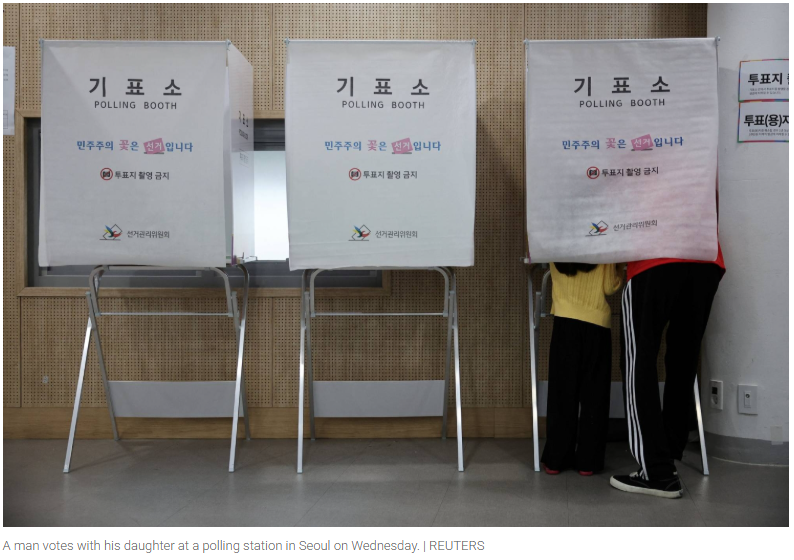
While the elections were largely peaceful nationwide, some polling stations in Seoul faced disruptions due to a shortage of ballots. The shortage sparked protests from hundreds of voters, leaving thousands of ballots uncollected as of Thursday morning, according to Yonhap News. The NEC issued an apology for the mishap but ruled out a revote.
Since taking office a year ago, Lee has been riding a wave of support that has consistently hovered around 60% in polls. His administration has also benefited from a surge of global demand for artificial intelligence technology that has propelled South Korea’s semiconductor exports, helping power both the nation’s economic growth and sharp gains in its booming stock market.
With four years remaining in office, maintaining a stable relationship with the U.S. is one of Lee’s top priorities amid ongoing trade tensions and pending investment commitments. But voters are more concerned with the situation at home, particularly inflationary pressure stemming from the war in Iran and the rapid growth driven by the tech sector.
The issue of how to spread the benefits from the AI boom has emerged as a key flash point for the government as Samsung Electronics recently promised record bonuses to its chip workers to avert a strike.